
 Available in US
Content
- Why NFL prices read like a foreign language at first
- The three formats sitting on every UK NFL coupon
- American odds without the head-scratching
- Fractional odds: the British muscle memory
- Decimal odds and why sharper books default to them
- Moneyline: the bet that looks simplest and isn't
- Point spread mechanics in plain English
- Totals: the market British punters underuse
- Implied probability: the only number that matters
- Vig and overround on UK NFL lines
- Line movement: reading the tape
- Comparing prices across UK books
- Frequently asked questions
- Reading the board like the house does
Why NFL prices read like a foreign language at first
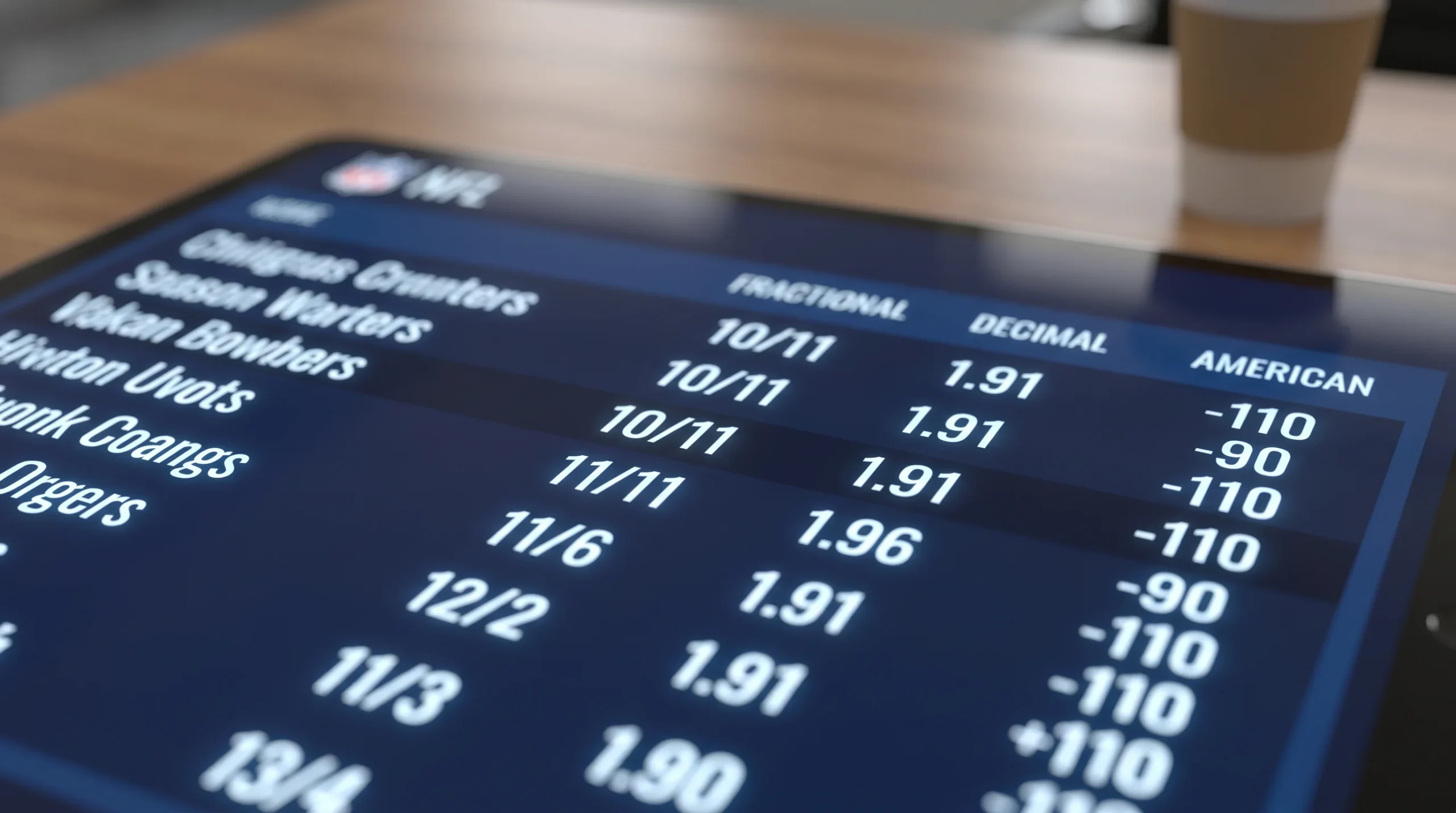
The first time I tried to price an NFL game properly, I spent forty minutes arguing with myself about whether 10/11 was a better number than -110. Spoiler: they are literally the same price, dressed in different clothes. That moment of confusion is the entire problem with NFL odds for a British punter. You arrive carrying a fractional Premier League brain, you open an American spreadsheet, and somewhere in the middle a decimal price drifts past on Pinnacle and you wonder if anyone is going to translate.
The good news is that there are only three formats, two markets that matter, and one piece of arithmetic — the vig — that decides whether a price is worth backing. Everything else is dressing. As one analytical brief put it, most UK punters arriving at NFL from football are surprised that the totals number is a real bet rather than a sideshow
, and that single sentence captures how different the priorities are once you cross the Atlantic. By the end of this guide, fractional, American and decimal will all read the same to you, and you will know exactly which of the three to use when you are sitting in front of a Sunday slip.
The three formats sitting on every UK NFL coupon
Open any UK-licensed sportsbook on a Sunday in November and you will see the same NFL fixture priced three different ways inside the same account. Toggle settings change the display; the underlying number is identical. The reason for the three-format world is historical and audience-driven, not mathematical, and once you see that it stops feeling chaotic.
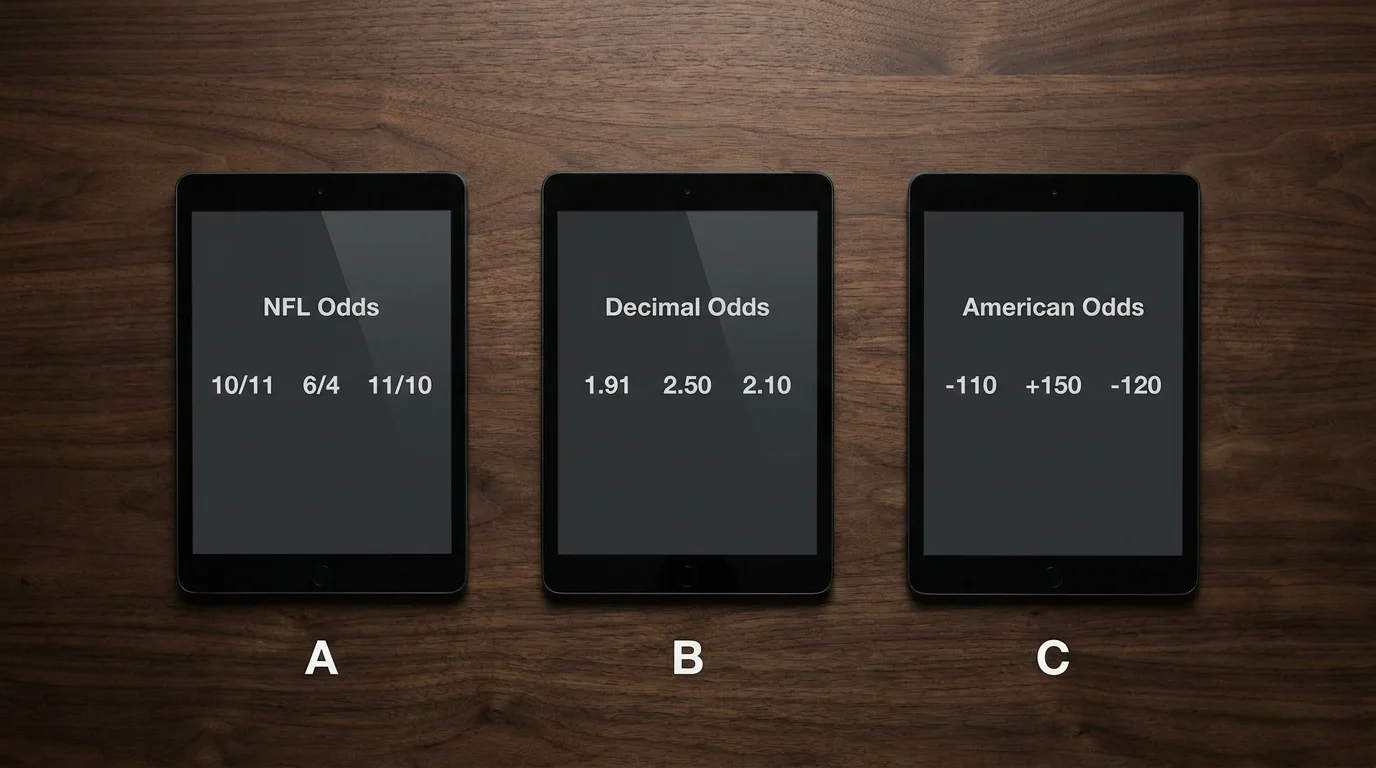
Fractional odds — 10/11, 6/4, 11/10 — are the British inheritance from the racecourse. They tell you what you win on top of your stake. A £10 bet at 10/11 returns £19.09 in total (£9.09 profit plus your tenner back). British retail betting was built around this format, and most UK sportsbooks still default to it.
American odds — -110, +175, -350 — were built around a notional $100 unit. A minus number tells you how much you have to stake to win 100; a plus number tells you how much you win on a 100 stake. They look brutal to a UK eye but they are excellent for spreads and totals, where both sides usually sit at -110 and the symmetry is obvious at a glance.
Decimal odds — 1.91, 2.50, 4.50 — give you the total return per unit staked, your stake included. A £10 bet at 1.91 returns £19.10. Decimals are the format used by sharper books, by every Pinnacle-style operation, and by anyone running a model in a spreadsheet, because you can multiply them together to get parlay prices without breaking a sweat.
For NFL in particular, the format you choose changes how quickly you can spot value. Fractional is fine for outright winners and futures. Decimal is fastest for line shopping. American is the cleanest way to read a spread board, because it shouts the juice at you. Pick whichever you read fastest, but learn to translate, because the sharpest pricing context for NFL still arrives in American notation from the US market.
American odds without the head-scratching
I keep two reference points pinned at the top of my notes: -110 means risk 110 to win 100, and +100 is even money. Everything else is a slide between those poles. If a quarterback is +275 to throw three touchdowns, you risk 100 to win 275. If a team is -200 on the moneyline, you risk 200 to win 100. That is the whole engine.
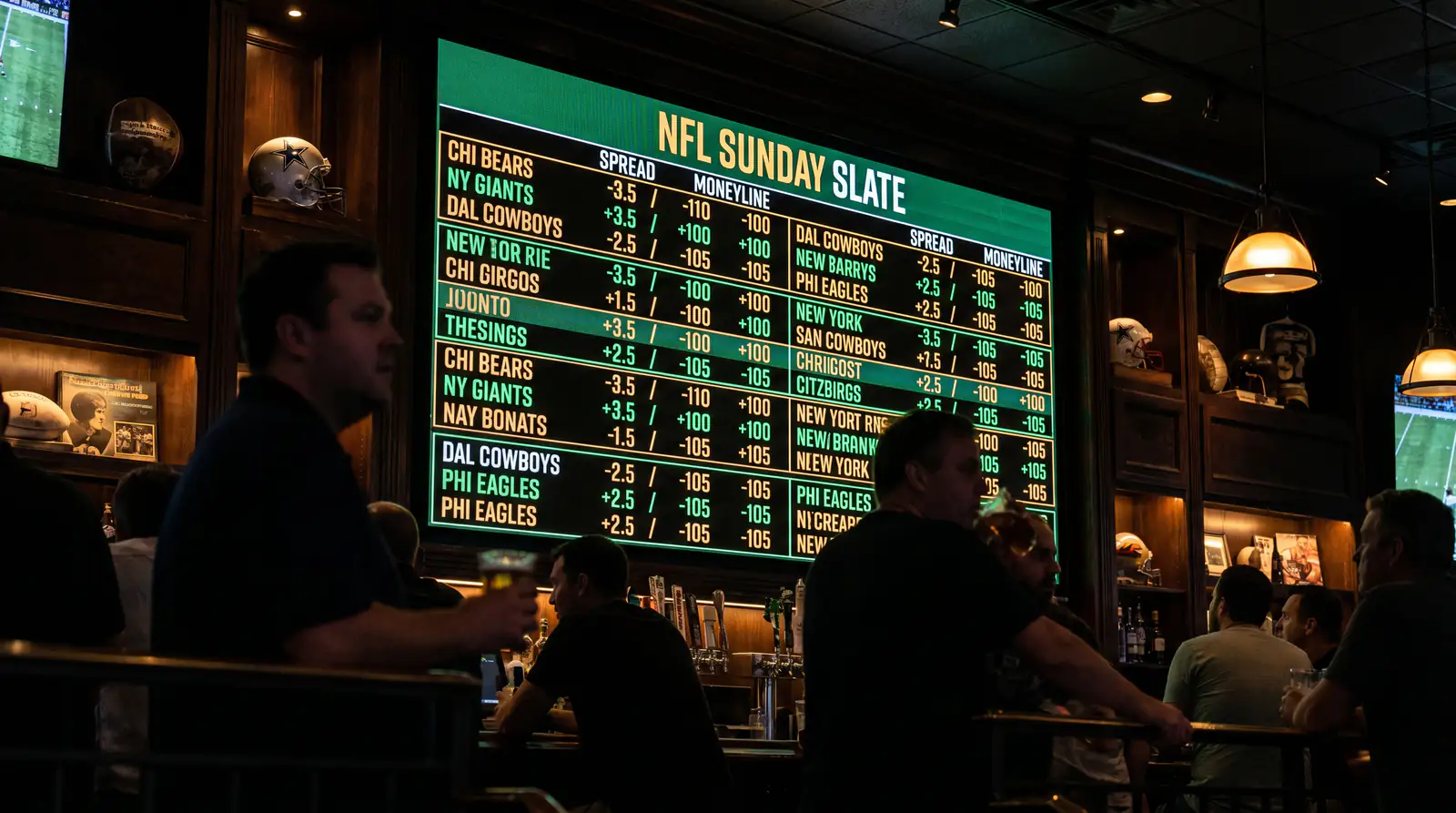
The convertor most British punters need lives in their head, not in an app. To turn a negative American price into a decimal, divide 100 by the absolute value and add 1. So -110 becomes 100/110 + 1 = 1.909. To turn a positive American price into a decimal, divide it by 100 and add 1. So +275 becomes 2.75 + 1 = 3.75. From decimal to fractional is the last hop: subtract 1 and find the nearest familiar ratio. 1.909 is 0.909, which is essentially 10/11. 3.75 is 2.75, which is 11/4.
The reason American notation persists in NFL coverage, even on UK platforms, is that it makes the bookmaker margin obvious. When you see -110/-110 on a spread, the juice is staring at you. When you see 10/11 and 10/11 on the same market, the juice is hidden behind two fractions that look like they cancel out but absolutely do not. Sharps speak American because it tells them the truth faster, and that is the only reason a British punter ever needs to bother with the format.
One warning: do not assume an American price is more authoritative because it looks more technical. A line is a line. The sportsbook that sets the sharpest opener and the one that copies it twenty minutes later might display the identical price in identical notation. Notation is not provenance.
Fractional odds: the British muscle memory
Fractional notation is intuitive once you remember that the slash is doing the job of the word “to.” 6/4 reads as six to four — risk four, win six. 10/11 is the awkward one because the second number is bigger, but it still works: stake eleven to win ten. The reason it is awkward is that for any short-priced market like an NFL spread, you are inherently risking more than you stand to gain, and the British way of writing that price refuses to round it down.
Where fractional gets uncomfortable for NFL is in the player prop and futures aisle. Anytime touchdown scorer prices like 5/6, 8/13, 4/9 all look broadly similar to a British eye, even though they sit at meaningfully different implied probabilities. A passing yards over priced at 5/6 is roughly 54.5% implied. A passing yards over at 8/13 is 61.9%. That seven-point gap matters when you are stacking legs in a same-game multi, but it is barely visible in fractional notation. Decimal makes the gap shout — 1.83 versus 1.62. American makes it shout louder — -120 versus -163.
My working habit is to use fractional for the bet I am actually placing, because that is what the slip will display, and decimal for the spreadsheet where I price the game. The two formats are doing different jobs. The slip is asking how much I will get back. The spreadsheet is asking whether the number is fair.
Decimal odds and why sharper books default to them
Decimal is the diplomat in this conversation. It speaks to all three audiences and offends none of them. You take a stake, you multiply by the decimal price, you get your return. A £20 bet at 1.91 returns £38.20. A £20 bet at 2.50 returns £50. There is no translation, no fraction, no plus/minus distinction.
The reason every model-driven operation in betting — sharp books, syndicates, exchange traders — uses decimal is parlay maths. To work out a five-leg accumulator in fractional, you have to convert everything to decimal anyway. The fractional return formula collapses under the weight. In decimal, you multiply five numbers together and you have your final price. A five-fold of 1.91s prices at 1.91^5 = 25.36, which is a return of £253.60 on a tenner.
For NFL specifically, decimal is also the format I would suggest learning if you plan to do any line shopping at all. The differences between 1.91 and 1.95 are immediately obvious as percentages of return. The same gap in fractional is 10/11 versus 19/20, and most British punters do not have those ratios stored next to each other.
Moneyline: the bet that looks simplest and isn’t
A moneyline bet is just “who wins outright.” No spread, no handicap, no totals. The team wins, you win. It feels like the easiest market on the slip and that is precisely why it is dangerous. Heavy favourites on the moneyline drain bankrolls faster than any other market in American sport, because punters keep backing them at prices that demand a strike rate they will never sustain.
Here is the maths that matters. A team priced at -250 needs to win 71.4% of the time just for you to break even. That is before the vig. The 2025 Chiefs, even at their statistical peak, did not win road games at 71%. Backing them at -250 is therefore a losing position in expectation, even though it feels like backing a sure thing. The moneyline tax on perceived certainty is brutal, and it is the single biggest reason I tell new NFL punters to read the spread before they read the moneyline.
Where the moneyline earns its keep is on dogs. A +175 underdog needs to win 36.4% of the time to break even — a hurdle that good road dogs clear consistently in the right spots. Divisional underdogs, healthy home dogs in primetime, dogs catching a bye-week favourite — these are the moneyline plays that pay rent. The market most British punters use as a default is, for sharps, a contrarian instrument.
Pricing on NFL moneylines also moves faster than on spreads, because retail money piles into favourites in the final hour before kickoff. If you want a moneyline favourite, place it early. If you want a moneyline dog, wait. That is a strategic detail you will not find on the front of any UK coupon, but it is true on every Sunday I have tracked it.
Point spread mechanics in plain English
The spread exists because most NFL games are not even matchups. If the Chiefs play the Browns, the moneyline on the Chiefs would be brutally short and the moneyline on the Browns would be politely interesting. Nobody wants either bet. So the bookmaker invents a handicap — say Chiefs -7.5 — that adds 7.5 points to the Browns’ final score for betting purposes only. Now both sides are priced around -110, and the question is no longer “who wins” but “do the Chiefs win by eight or more.”
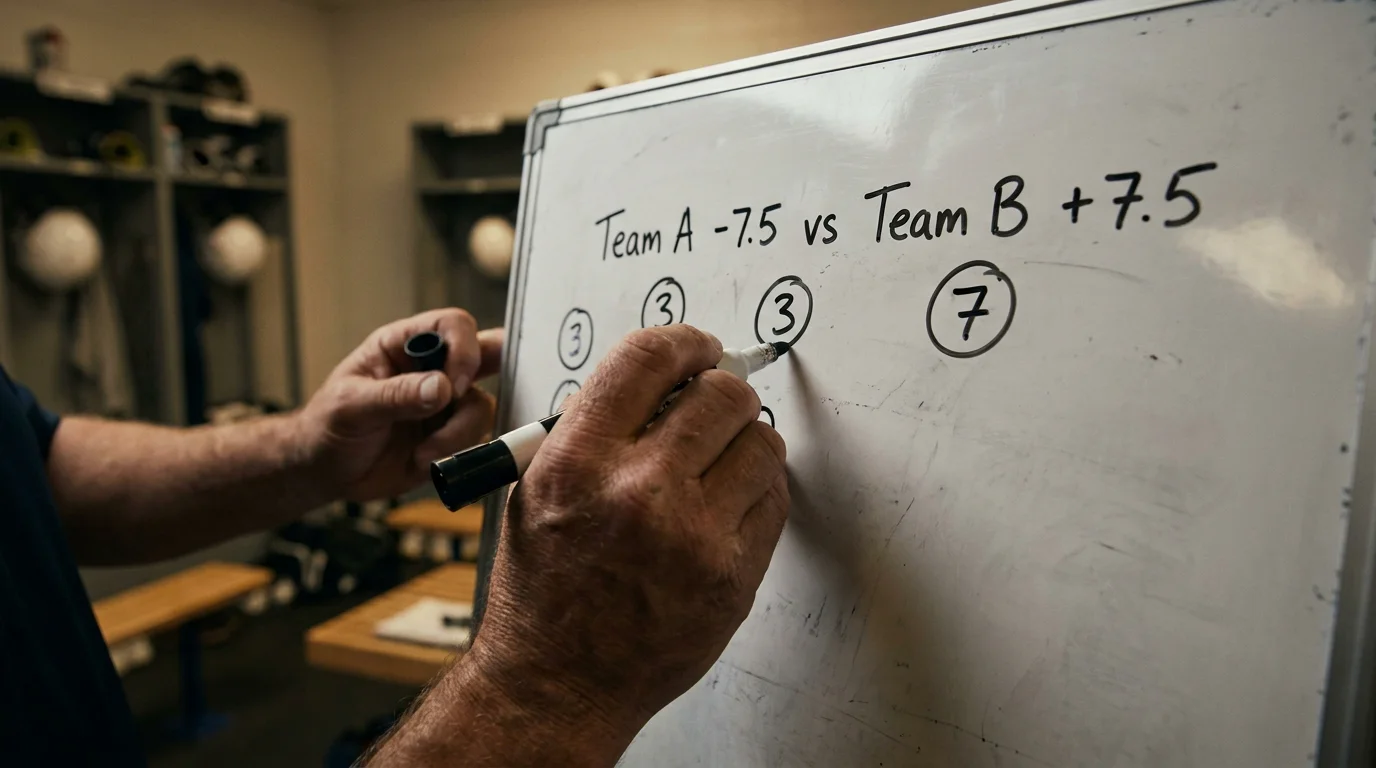
If a UK punter has ever bet an Asian handicap on a Premier League game, the mechanics are identical. The point spread is the NFL’s universal handicap, and the half-point in -7.5 is there to prevent a push (a tie at the number, which returns your stake). Whole-number spreads — Chiefs -7 flat — do allow pushes, and a result of Chiefs by exactly seven is a no-bet.
The key numbers in NFL spread betting are 3 and 7, because those are the most common scoring margins. A field goal is three. A touchdown plus extra point is seven. Spreads cluster around these numbers and move in half-point increments around them. Buying a half-point from 3 to 2.5 typically costs more than buying from 5 to 4.5, because crossing a key number changes the underlying probability meaningfully. The bookmakers know this. The line shop knows this. If you do not, you will pay full price for a price improvement that was always cheap to the house.
Spread pricing in the UK arrives at 10/11 most of the time, which translates to -110 American. That is the standard juice. When you see a spread priced at 5/6 — which is roughly -120 — the book is telling you something. Either the line is sharp and they want to discourage one side, or steam money has hit and they are protecting the position. Both are signals worth reading.
Totals: the market British punters underuse
On a Premier League slip, the totals market is usually quiet. On an NFL slip, it is frequently the most-traded line on the board. The structural reason is that football scoring is granular — every drive can produce 0, 3, 6, 7 or 8 points, and there are typically twenty-plus drives in a game. The total moves on every possession. The total invites in-play. The total rewards weather and pace research more than the spread does, because spread bettors can sometimes cancel out a pace edge with a sharp line, while totals bettors are pricing a number that grows or shrinks every play.
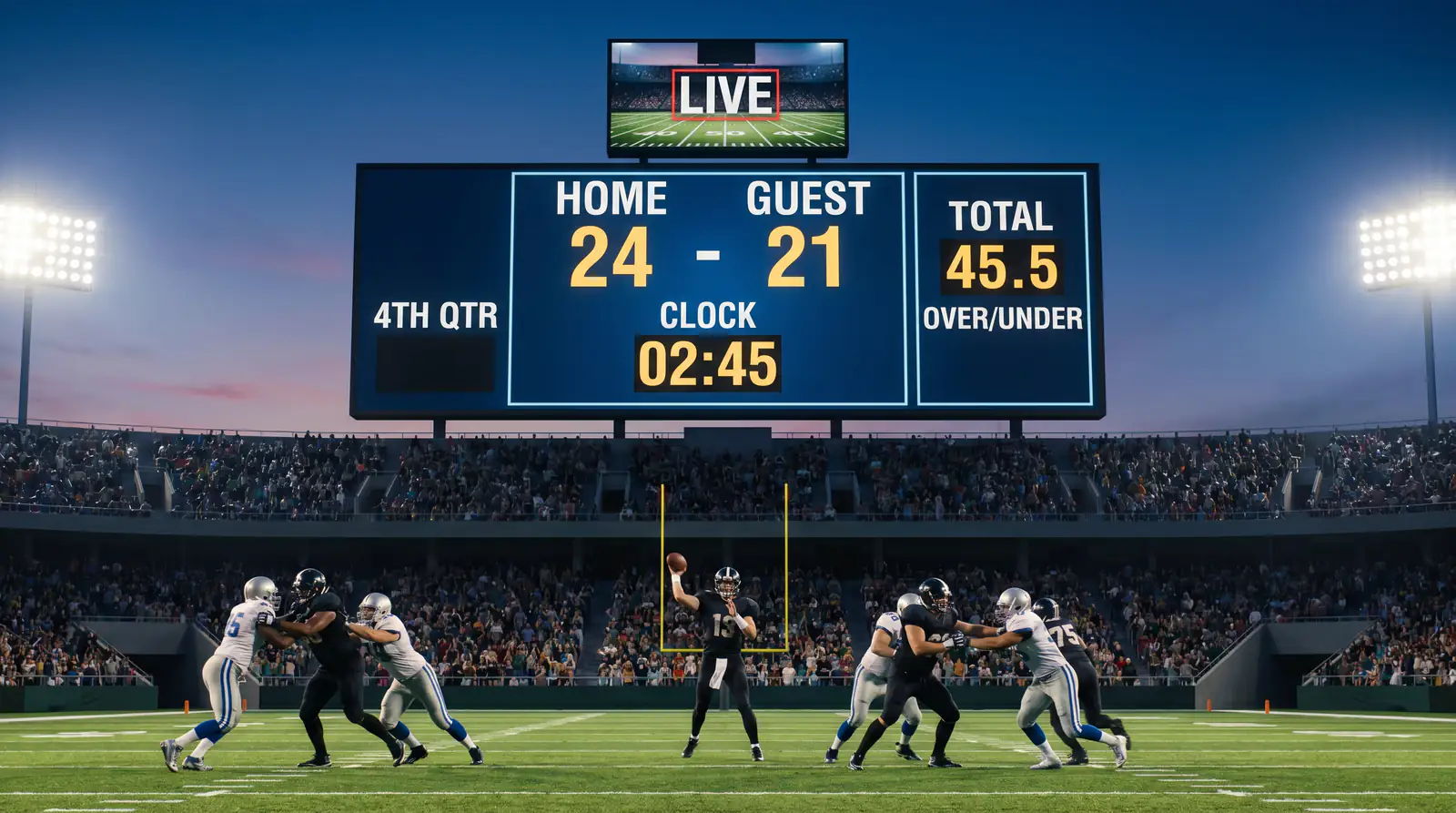
A typical NFL total in 2026 sits between 41.5 and 49.5, with regular-season averages around 44–45. The over and under are usually both priced at 10/11. The 45.5 number is to NFL totals what 2.5 goals is to soccer — the canonical price the public lives on. The difference is that an NFL total of 45.5 implies roughly twice the variance of an Old Trafford under 2.5, because field goals are partial scores.
Where totals get interesting for a British punter is in the live market. Pre-match totals are sharp. Live totals, especially in the second half, are softer, because the line has to update on every drive and the algorithm sometimes overreacts to early-game scoring patterns. A 13-3 first half does not mean a low-scoring full game; it often means a 24-21 final once both offences settle. The sharp under in those games is priced too short. The sharp over is the bet.
Implied probability: the only number that matters
Every price you have ever seen on an NFL coupon is just a probability dressed in clothes. Implied probability is the number underneath, and once you can read it, every market in every notation collapses into the same conversation. The decimal formula is the cleanest: divide 1 by the decimal price and you get the implied probability. So 1.91 implies 52.4%. 2.50 implies 40%. 4.00 implies 25%.
For American odds, negative prices use the formula |price| / (|price| + 100). So -110 is 110 / 210 = 52.4%. Positive prices use 100 / (price + 100). So +175 is 100 / 275 = 36.4%. Memorise the canonical anchors — -110 is 52.4%, +100 is 50%, -200 is 66.7%, +200 is 33.3% — and you will read any American board at a glance.
The reason implied probability matters more than any other number in this guide is that it tells you whether a price is fair. If you genuinely believe a team wins 55% of the time and they are priced at -110 (52.4% implied), you have positive expected value. If you believe they win 50% of the time and they are priced at -150 (60% implied), you are buying at a markup. The vast majority of recreational NFL bets are placed without anyone working out the implied probability, and that is the single biggest reason recreational NFL punters lose money even when they understand the sport.
Vig and overround on UK NFL lines
The vig — also called juice, also called overround — is the bookmaker’s margin built into the price. On a two-way market like a spread, both sides are typically priced at -110, which implies 52.4% on each side. Add them together and you get 104.8%. That extra 4.8% is the vig. The book is selling you 104.8 pence of probability for every pound of price, which is why no fair-coin bet at -110/-110 ever breaks even over time. The vig is what the house keeps.

In the wider UK market, you can see how lucrative this maths is from the headline numbers. The remote casino, betting and bingo sector turned over £7.8bn in gross gambling yield across the year to March 2025, a 13.1% rise on the prior twelve months. Real-event online betting alone hit £596m in a single quarter at the end of that period. Those are the aggregated returns of every market with juice baked in, NFL among them, and they are the structural reason the house wins even when it gets the line wrong.
Overround on NFL spreads in the UK typically sits between 4% and 5% on the major books, and the sharper end of that range will be the books that take the most NFL volume. Player props and same-game multis carry far heavier juice — often 8% to 15% — because the markets are thinner and the bookmaker is pricing correlation as well as outcome. If you only ever do one thing differently on your NFL slip from this guide, calculate the overround on the market you are about to bet. Anything north of 6% on a two-way market is a market you should be line-shopping, not accepting.
The toolkit for stripping juice is short and worth learning. A full walkthrough of how to work the vig out of any NFL line sits in the deeper guide, but the headline rule is: convert both sides to implied probability, sum them, divide each side by the sum, and you have the no-vig price.
Line movement: reading the tape
Lines move for two reasons. Either new information arrived — an injury, a weather change, a coaching reveal — or money arrived. Both move the number, but they move it differently. Information moves it cleanly and stays. Money moves it sharply and sometimes reverses.
The Wednesday opener on a Sunday game is the sharpest number you will see all week, because it is the book’s honest opinion before the public weighs in. By Friday afternoon, retail money has shaped the line. By Sunday morning, late-week injuries and lineup news have shaped it again. The closing line — the price at kickoff — is the consensus that all the money has settled on, and historically it is the most accurate predictor of game outcomes in any major sport.
This is also why early lines reward research and late lines reward news. If you have a model that prices the game before the openers come in, the Wednesday number is your friend. If your edge is processing late information faster than the market — a Saturday injury report, a Sunday morning weather update — the late line is yours. There are 13.5m active online gambling accounts in Britain on any given month, and the closing line is the weighted opinion of all of them. Beating it consistently is the only definition of being a winning punter that actually holds up.
Comparing prices across UK books
Line shopping is the simplest edge in betting and the one most British punters skip. The 5,825 betting shops licensed across Britain in 2024-25 reflect a market with multiple operators competing for the same bet, and on any given NFL fixture you will find a half-point of difference on the spread between the two ends of the high street. Half a point on a key number is worth real money over a season.
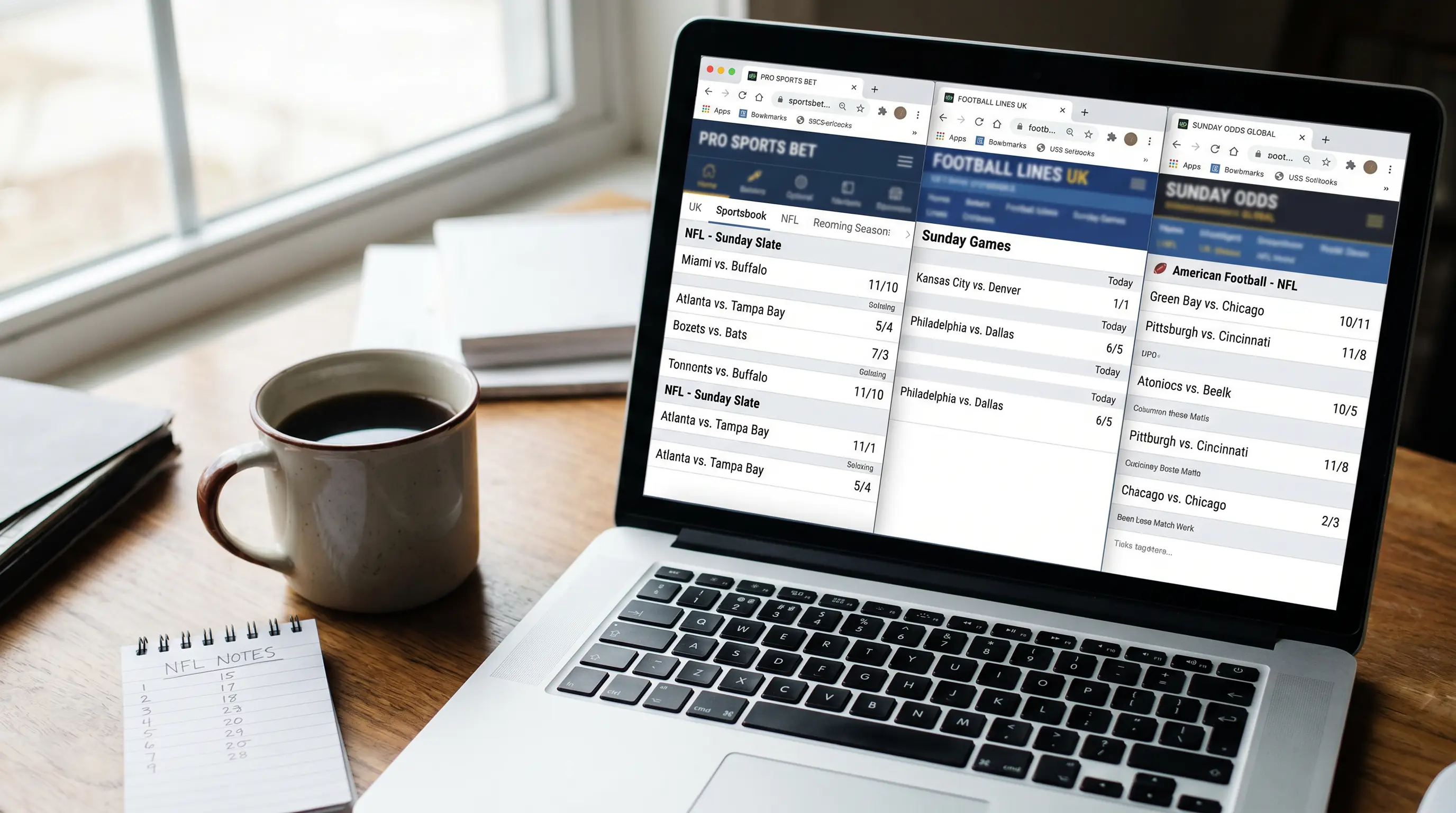
The mechanical version is to keep three to five UK-licensed sportsbooks open in tabs on Sunday morning, type the line you want into each, and bet the best price. The professional version is to do that for every leg of every parlay, and to track which book consistently posts the best price on your preferred markets. Some books are reliably the best on totals. Others are the best on player props. Almost none are the best on everything.
The disciplined version of all this is to refuse to bet a line that is not the best available. That sounds extreme. It is the difference between being a long-term winner and a long-term loser at NFL betting, and it costs you nothing except the time to open a second tab.
Frequently asked questions
Why do UK bookmakers price NFL games in fractions but quote American odds elsewhere?
The fractional default is a UK retail convention inherited from horse racing. American odds remain on the same coupon because the sharper context for NFL pricing arrives from the US market, where -110 is the universal spread price. Every UK sportsbook will let you toggle between fractional, decimal and American in account settings.
How do I quickly convert -110 to fractional odds in my head?
-110 means risk 110 to win 100, so you are getting 100/110 in fractional terms. The closest familiar ratio is 10/11. Memorise that single equivalence and you will read 90% of NFL spread and total markets without doing any maths.
What overround should I expect on a typical NFL spread market in the UK?
A standard two-way NFL spread priced at 10/11 each side carries an overround of roughly 4.8%. Anything materially above 6% on a two-way market is a sign you should line-shop. Player props and same-game multis carry far heavier juice, often 8% to 15%.
Reading the board like the house does
The point of every conversion, every formula and every overround calculation in this guide is to put you on the same side of the table as the book. The house does not look at a spread and feel anything. It looks at a number, computes the implied probability, compares it to its own model, and books the bet only if the price is in its favour. That is the entire business. You can either play their game blind, or you can learn to do the same arithmetic with the same tools, and decide which prices are worth your money. The translation between formats is the first step. The implied probability and the vig calculation are the second. Everything after that is just NFL.
