
 Available in US
Content
- The one night British NFL betting becomes a stadium
- The numbers that shape the night
- The UK Super Bowl handle and where it lands
- The outright winner market through the season
- Conference futures and the cleaner price
- Divisional futures and stacking value
- MVP odds and the Super Bowl angle
- Props on the night: where the book makes its money
- Live in-play during the game
- UK TV coverage and the timing problem
- The franchise takes from London
- Bankroll discipline on Super Bowl Sunday
- Frequently asked questions
- One night, three different books
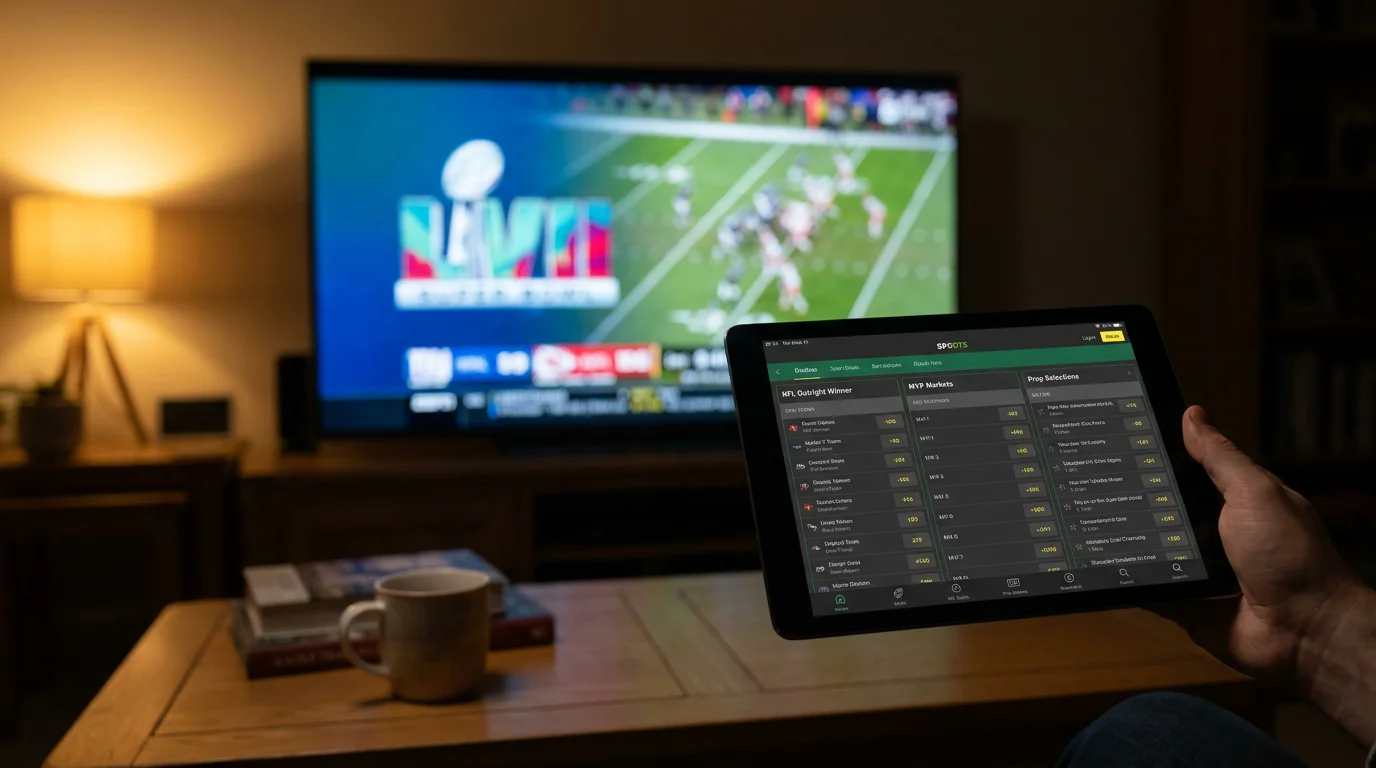
The one night British NFL betting becomes a stadium
The Super Bowl is the only event in the American sporting calendar where my phone notifications go quiet for four hours and then explode at 03:30 GMT with messages from people who had absolutely no opinion on the NFL three weeks earlier. Around 68 million American adults plan to bet on a given Super Bowl, with roughly $23.1bn changing hands across regulated and unregulated channels in the US alone. The UK proportion is smaller but no less concentrated — a single night of betting that exceeds the handle of an entire regular-season weekend.
What makes Super Bowl LX worth a guide of its own is not the sport. The football is the football. What changes is the market structure: outrights priced months in advance, novelty props priced minutes in advance, and a UK kickoff time that turns the in-play window into a five-hour overnight grind. If you bet the Super Bowl the way you bet a regular-season Sunday, you are leaving money on the table on at least three different markets. This guide is the corrective.
The numbers that shape the night
The Super Bowl is the most-bet sporting event in the world, and it is not particularly close. The combined NFL and college football wager market is estimated at over $75bn annually, with the bulk concentrated in North America, and the championship game accounts for a share of that figure entirely disproportionate to its 0.6% slot in the calendar. Roughly $23.1bn moved through betting channels on Super Bowl LVIII in February 2024 — a figure that has grown every year since US sports betting regulation expanded in 2018.
The UK slice of that handle is harder to size precisely, but Sunday-night-into-Monday-morning fluctuations in UK online betting volumes during Super Bowl windows are visible in the aggregated quarterly data. The fourth-quarter remote real-event betting figure of £596m in 2024-25 includes a Super Bowl contribution large enough to move the trendline. For UK sportsbooks, the Super Bowl is the single biggest standalone non-soccer event of the year.
What matters about those numbers, for a punter, is the implication for line behaviour. The Super Bowl receives more sharp attention than any other game on the calendar. The opening number is hyper-sharp, and the closing number is the most efficient single sports betting price you will encounter all year. Beating the closing line on the Super Bowl spread is the hardest test in NFL handicapping. Beating the closing line on the novelty props is comfortably the easiest — because the books deliberately price them with heavy juice and rely on retail money to absorb the margin.
The UK Super Bowl handle and where it lands
Around 6% of UK adults bet on live football in any given quarter, but Super Bowl Sunday produces a participation spike that briefly drags the NFL share toward — and sometimes past — football levels for that single night. The British Super Bowl audience is broader than the regular-season audience, deeper than the casual midweek football audience, and disproportionately weighted toward first-time NFL bettors who are watching because their flatmates are.
That audience composition tells you exactly which markets get over-bet and which get ignored. The outright winner market on Super Bowl Sunday itself is over-bet to a punishing degree — the closing price on the favourite is almost always shorter than it should be, because retail money piles in on the perceived stronger team. The spread, by contrast, is one of the sharpest single numbers in all of betting by kickoff. The total moves the least of any market through the build-up week, because the model on Super Bowl total scoring is unusually well-calibrated.
The markets that get the least sharp attention from retail are the prop bets specifically tied to player performance — passing yards, longest reception, receptions on the third-leading receiver — and these are the props where a UK punter with a model can find honest value. The novelty props (coin toss, national anthem length, Gatorade colour) are not value bets. They are a form of entertainment, and they are correctly priced as entertainment by the book.
The outright winner market through the season
The Super Bowl outright market opens the day after the previous Super Bowl ends. The first prices you will see on Super Bowl LX appear in February of the prior year, with the defending champion at the shortest price and the bottom of the league priced as longshots in the 100/1 to 300/1 range. From that moment until the conference championship games in late January, the outright market is in continuous motion — every game, every injury, every coaching change moves the number.
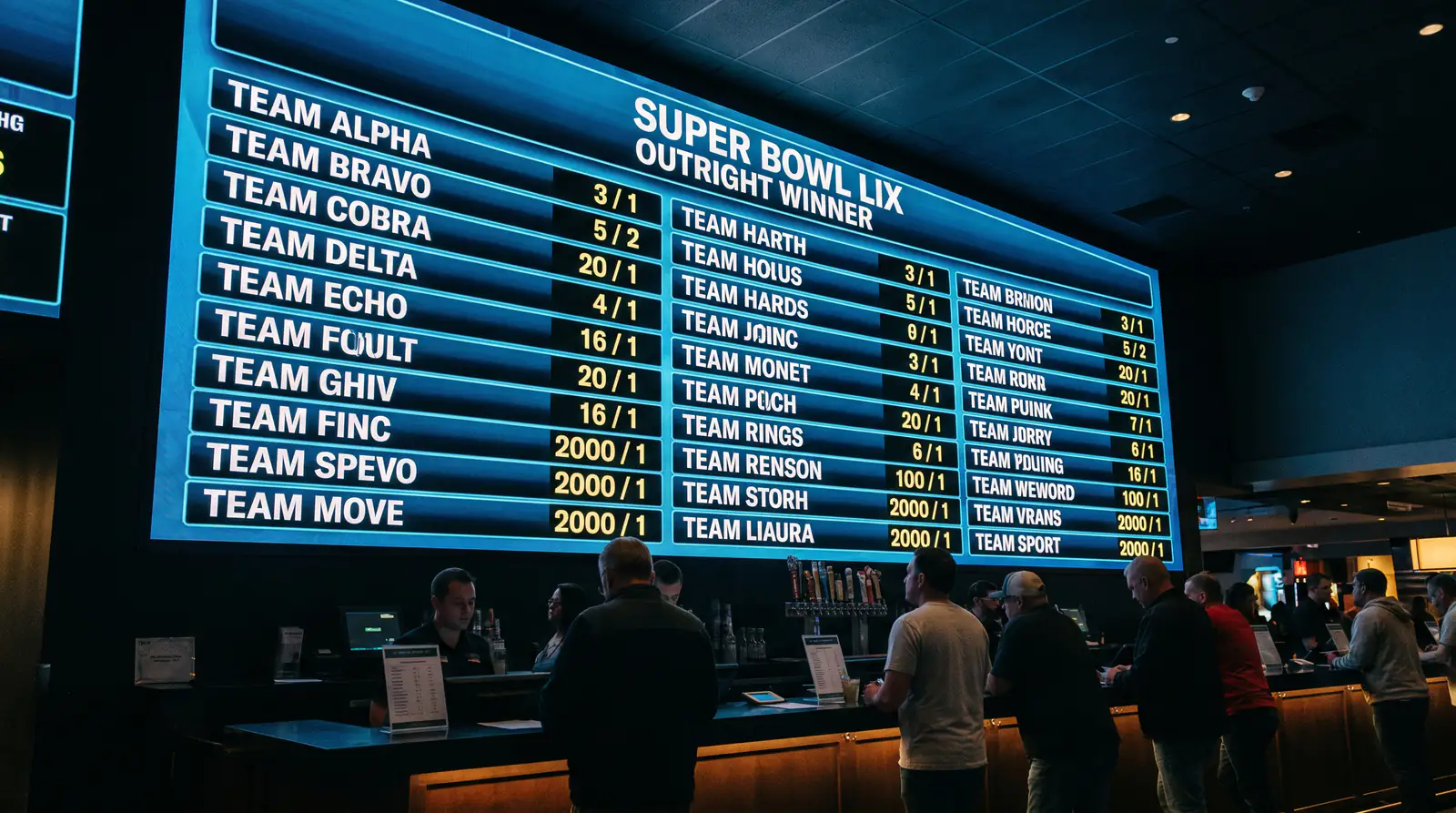
The structural feature of the outright market that British punters routinely misread is the overround. A 32-team book on the Super Bowl winner can carry an overround of 130% or more — that is, the implied probabilities of every team add up to 1.30 instead of 1.00. The 30% margin is the book’s protection against the unknown, and it is the reason a 12/1 Super Bowl future is not really a 12/1 price. The true price, stripped of vig, is closer to 16/1 or 18/1.
Where the outright market becomes interesting is the window between Week 1 and Week 10. The opener priced in summer has been built off the previous season’s data, training camp reports, and offseason transactions. By Week 10, you have eight weeks of actual evidence, and the smart money has had time to digest it. Teams that opened at 25/1 and are sitting at 12/1 by Week 10 have usually had their price corrected. Teams that opened at 8/1 and are still at 8/1 in Week 10 despite an indifferent start are usually being kept short by the books because they expect a late-season run. The mid-season window is where you decide which Super Bowl future is worth your money and which is dead capital sitting in your account for five months.
The other piece of the outright market worth your time is the second-tier prices — the 14/1 to 25/1 range. Outright favourites at 5/1 are usually fairly priced. Genuine longshots at 80/1 are usually appropriately doomed. The teams that get mispriced live in the middle, where the public has a strong opinion that is not quite right and the book has shaded the line to accommodate the flow.
Conference futures and the cleaner price
If the 32-team outright book is overround-bloated, the 16-team conference winner book is structurally cleaner. Both conference winner books typically run at 115-120% overround — still juiced, but far less than the full Super Bowl book. The maths is simple: fewer outcomes, less margin for the bookmaker to hide.
For UK punters, the conference future is the sharper version of the Super Bowl outright bet. If you fancy a team for the championship, the AFC or NFC future will pay you almost the same return — because to win the Super Bowl, you have to win the conference first — at a meaningfully shorter overround tax. The trade-off is that you lose the Super Bowl game itself if your team makes it; you have already cashed at the conference championship.
For hedging purposes, the conference future is also the better instrument. If you backed a team at 20/1 to win the Super Bowl before the season and they reach the championship game, you can lay the opposing team on the conference market — at much better effective odds than on the Super Bowl winner market — to lock in a return. The hedging maths on Super Bowl futures is one of the few genuinely useful pieces of betting arithmetic, and the conference winner price is almost always the right vehicle for it.
Divisional futures and stacking value
The divisional winner markets — eight markets, four teams each — are the cleanest priced of all the long-term NFL future bets. Overround on a four-team divisional book typically sits at 108-112%. That is roughly the same overround as a coin-flip spread, which is to say barely there.
The reason divisional futures are tighter is that the books have less to model. Four teams, sixteen division games, and a known set of common opponents make the outcome distribution far more predictable than a full Super Bowl run. Where a Super Bowl future is essentially a three-game playoff bet on top of a regular-season qualification bet, a divisional future is a single regular-season race priced with reasonable accuracy.
For a UK punter looking to stack divisional and conference futures together for a bigger return, the AFC South and NFC East have historically been the divisions where the public consensus is most wrong, and where the contrarian price has paid out the most often. The AFC West is the division where consensus is right most often and the contrarian price loses. None of that is timeless, but it is the pattern of the past five seasons, and it is worth checking against the current year’s market when you are picking divisional dogs to back long.
MVP odds and the Super Bowl angle
The Super Bowl MVP market and the regular-season MVP market are two completely different bets, even though they share a name. The regular-season MVP almost always goes to a quarterback whose team finishes top three in the conference. The Super Bowl MVP frequently does not — it has gone to non-quarterbacks in roughly a quarter of the games over the past decade, with running backs and defensive players accounting for most of the deviation.
The structural reason is that the Super Bowl MVP is a single-game performance award, not a season award. A defensive player who has a two-sack, one-interception game wins it more often than the quarterback who threw three touchdowns but also had a turnover. The market knows this, but it does not always price it correctly — favourite quarterbacks at 8/11 on Super Bowl MVP are systematically overbet, because the public conflates regular-season MVP narrative with Super Bowl MVP probability.
The value bet on Super Bowl MVP is almost always a defensive front-seven player at 25/1 to 40/1, on the team you fancy to win the game. The probability of that player winning MVP, conditional on his team winning the Super Bowl, is materially higher than the implied probability of the price. The trick is that you need the team to win first, and the price reflects the joint probability.
Props on the night: where the book makes its money
Super Bowl prop markets are where the bookmakers extract their margin, and where retail punters most enjoy themselves. Both of those things can be true at once. The novelty props — first scoring play type, length of the national anthem, colour of Gatorade poured on the winning coach — are priced with overrounds of 15-25%. They are not value bets. They are taxes on having fun.
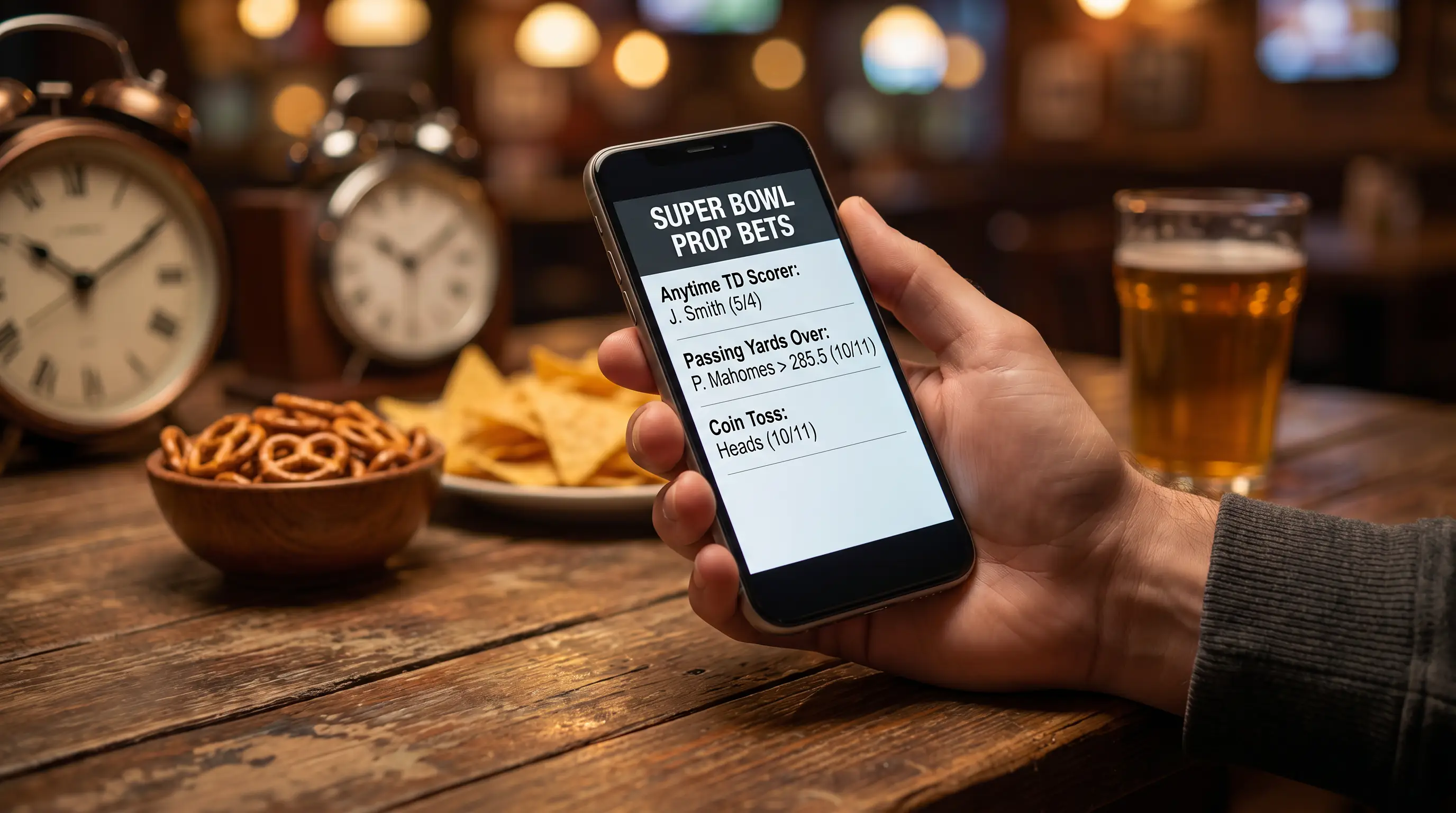
The performance props are where actual money can be made. Quarterback passing yards lines, running back rushing yards lines, leading receiver lines — these are the markets where you can run a model and find prices that the book has not perfectly calibrated. The Super Bowl gets so much pre-game attention that the books are sharper on these props than on regular-season versions of the same markets, but they are not bulletproof.
The single highest-value prop type on Super Bowl Sunday, in my reading of multiple years of closing lines, is the anytime touchdown scorer market on the third skill-position player for each team. The first option is usually priced shorter than fair. The second option is usually fair. The third option — the lower-target tight end, the secondary running back, the slot receiver — is consistently priced longer than fair, because retail money concentrates on the headline names. If you do one piece of prop research before the Super Bowl, work the third option on each side.
The same-game multi market on the Super Bowl is the most heavily juiced product on any UK sportsbook all year. Four-leg SGMs on the Super Bowl regularly carry overrounds north of 25%. Build them small, build them for fun, and do not treat the price as a serious offer.
Live in-play during the game
The in-play market on the Super Bowl is the longest single market of the NFL year. The game lasts roughly four hours real-time once commercials and the halftime show are factored in. The UK kickoff at 23:30 GMT puts the live betting window squarely between midnight and 03:30, which is both the cause of the market’s softness and the reason most British punters never make use of it.
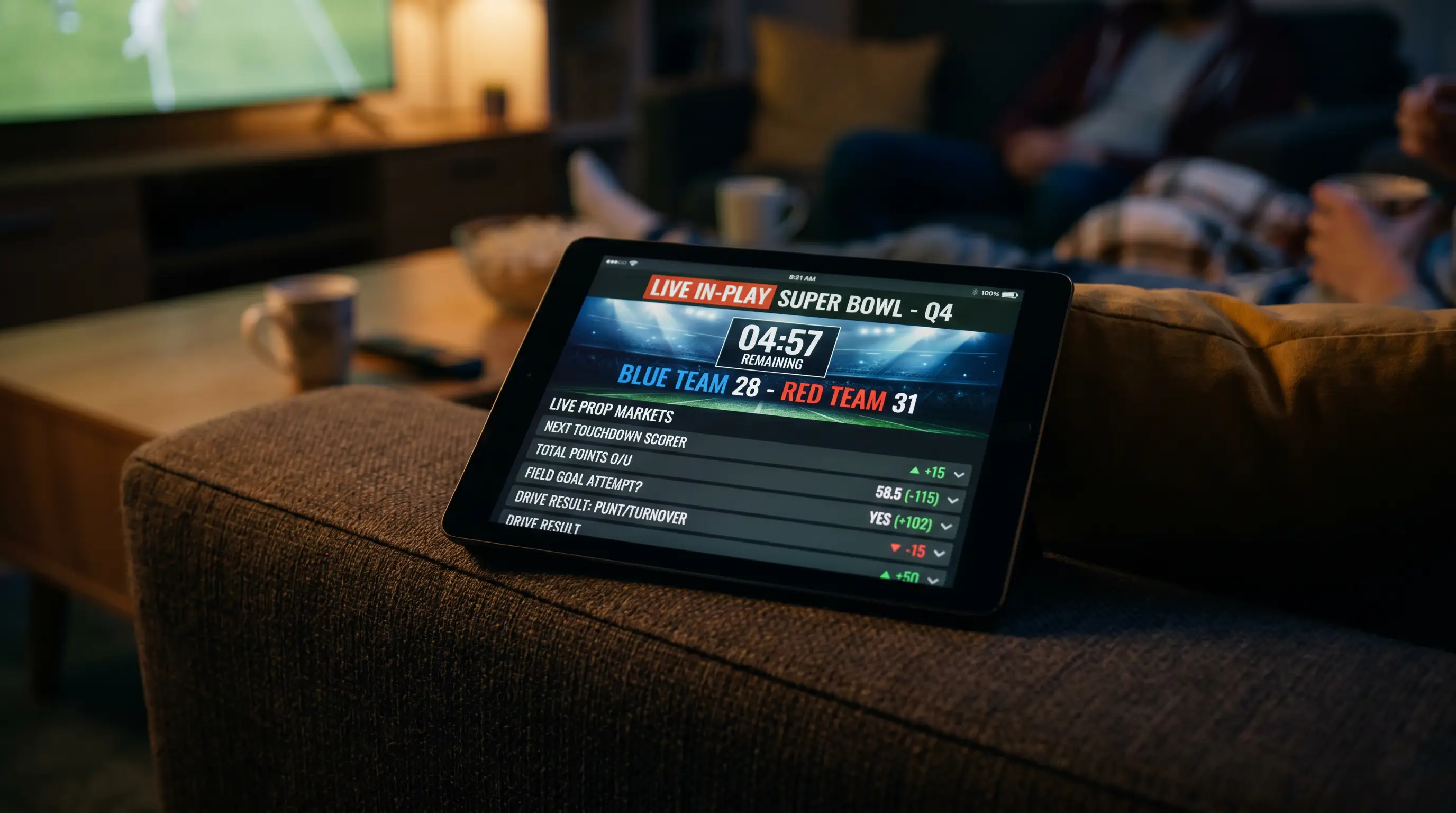
Live spreads on Super Bowl Sunday are sharper than live spreads on a regular-season game, because the books pay more attention. Live totals, by contrast, are softer — the Super Bowl scoring distribution is genuinely difficult to model in real time because of the halftime show pause, the longer commercial breaks, and the unusual coaching tendencies in a championship setting (more conservative early, more aggressive late). The over-under model trained on regular-season data underprices the second-half total in close Super Bowls.
The prop in-play market is where the real overnight value lives. Live “next score type” markets, live “drive outcome” markets, and live player prop overlays all carry softer juice than the pre-match versions, because the book has to update them on every play and the algorithm prioritises stability over sharpness. If you have stamina, the in-play prop market between the 8th and 10th drive of the game has historically been the highest-EV window on the entire NFL calendar.
One warning: stake discipline. The in-play market is designed to keep you betting, and the slip will let you compound positions in ways that look reasonable at 02:00 and absurd at 09:00. Cap your in-play unit at a quarter of your pre-game unit, and stop when you hit your cap regardless of how the game is going.
UK TV coverage and the timing problem
The Super Bowl kicks off at 23:30 GMT and ends, on average, around 03:30 GMT. The NFL signed an 11-year media deal worth $111bn, with the next opt-out at 2029, which means the broadcast economics of the Super Bowl are locked in for the foreseeable future. The UK broadcast partner has changed periodically over the past decade and will likely change again, but the kickoff time is structural — built around US prime-time television, not UK convenience.

That overnight window does three things to the British betting market. First, it concentrates pre-game handle into a narrow Sunday evening window, with most UK punters placing their main bets between 20:00 and 23:00 GMT. Second, it spreads in-play handle thinly across the four-hour broadcast, because a substantial portion of UK viewers are watching highlights on Monday morning rather than the live broadcast. Third, it makes Monday morning the largest sportsbook withdrawal day of the NFL calendar — which is its own signal about how the UK punter base has performed on the night.
For practical purposes, the timing means you should bet your pre-game positions before 22:00 on Sunday GMT, ideally with a target line you have noted earlier in the week. Trying to find value in the 22:30-23:30 window is fighting the closing crush. Trying to place serious in-play bets after 02:00 is fighting yourself.
The franchise takes from London
The Super Bowl is also the night the NFL’s broader strategic ambitions get aired publicly. Goodell on the Super Bowl rotation, Goodell on international expansion, Goodell on whether London or Madrid or Mexico City could host a championship game — all of it tends to make the news cycle in early February. We want to bring the entire NFL experience to our fans in London,
he said in a recent run of comments, and that line is repeated in every international Super Bowl conversation.
The market implication for UK punters is not direct — there is no Super Bowl future that prices “city of next Super Bowl” beyond the announced rotation — but the secondary implications are real. Every year the league commits more deeply to London, the share of UK retail handle on Super Bowl Sunday rises, and the line behaviour on UK-favoured props shifts accordingly. I would say that the markets outside the U.S. are very, very attractive,
Goodell said in a more recent interview, and the betting volumes are the evidence that backs the comment.
The further implication is that the futures market on a London-based team reaching a Super Bowl — currently a notional bet at a handful of specialist books — will eventually become a mainstream product. When it does, the early prices will be inefficient. That is a window worth watching.
Bankroll discipline on Super Bowl Sunday
The Super Bowl is the night more NFL bettors blow up their season than any other Sunday on the calendar. The mechanism is always the same: a punter who has bet within their unit size all season suddenly treats the championship game as a “must-win” or a “free hit,” doubles their stake, and discovers the meaning of variance on a single fixture. The first piece of Super Bowl bankroll advice is also the last one: keep your stake size identical to your regular-season unit. The championship game is one game.
The second piece is to budget separately for the novelty props. They are entertainment. Allocate 5% of your Super Bowl stake to the novelty book and accept that you are paying for the experience. Do not let the novelty bets bleed into the performance book, because the EV gap between the two is enormous.
The third piece is the hardest: have a plan for the futures you placed earlier in the season. If you backed a team to win the Super Bowl in September and they are now in the championship game, decide before kickoff whether you are hedging, partially hedging, or letting it ride. The decision made at 11pm on Super Bowl Eve is always better than the decision made at 23:25 on Super Bowl Sunday. The Bills’ Super Bowl LX outlook is the obvious worked example for the 2026 hedging conversation, but the principle applies to any future you carry into championship Sunday.
Frequently asked questions
When do UK bookmakers open Super Bowl LX outright markets?
The outright market opens the day after the previous Super Bowl ends. UK bookmakers typically follow within 48 hours, with a full 32-team price list available by mid-February of the prior calendar year. The opening prices are the inefficient ones — by Week 4 of the regular season, the market has corrected most of the obvious mispricings.
Are Super Bowl novelty props priced fairly or stacked with vig?
Stacked with vig. The standard overround on novelty props is 15-25%, several times higher than the spread or total. Treat them as entertainment, allocate a small fixed budget, and do not pretend you are placing a serious bet.
How does the GMT kickoff affect live betting decisions in the UK?
The 23:30 GMT kickoff puts the live betting window between midnight and roughly 03:30. The pre-game market closes harder than usual in the final hour before kickoff because of concentrated UK handle. The in-play market through the middle of the game is softer than its regular-season equivalent because the book is operating with thinner UK liquidity overnight. The price advantage is real if your bankroll discipline holds at 02:00.
One night, three different books
The single most useful frame for Super Bowl betting from the UK is that you are not betting on one game — you are betting in three distinct markets that share a fixture. The pre-game market is hyper-sharp and rewards specific edges, mostly on player props. The in-play market is wide and softer, and rewards patience and stake discipline. The novelty market is for fun and should be treated as a separate budget line. Mix them up and the night becomes a fog. Keep them separate and the Super Bowl becomes the most interesting single night of betting the calendar offers.
