
 Available in US
Content
- The market that ate the slip
- The props market in context
- Passing props: the cleanest data, the heaviest juice
- Rushing and receiving: the workload markets
- Touchdown scorer markets
- Defensive and special teams props
- How a same-game multi actually works
- Correlation and what the book is really pricing
- Bet builder tools and the UK product
- Prop Protect and early payout offers
- Where the props market traps the casual punter
- Frequently asked questions
- What the props market rewards
The market that ate the slip
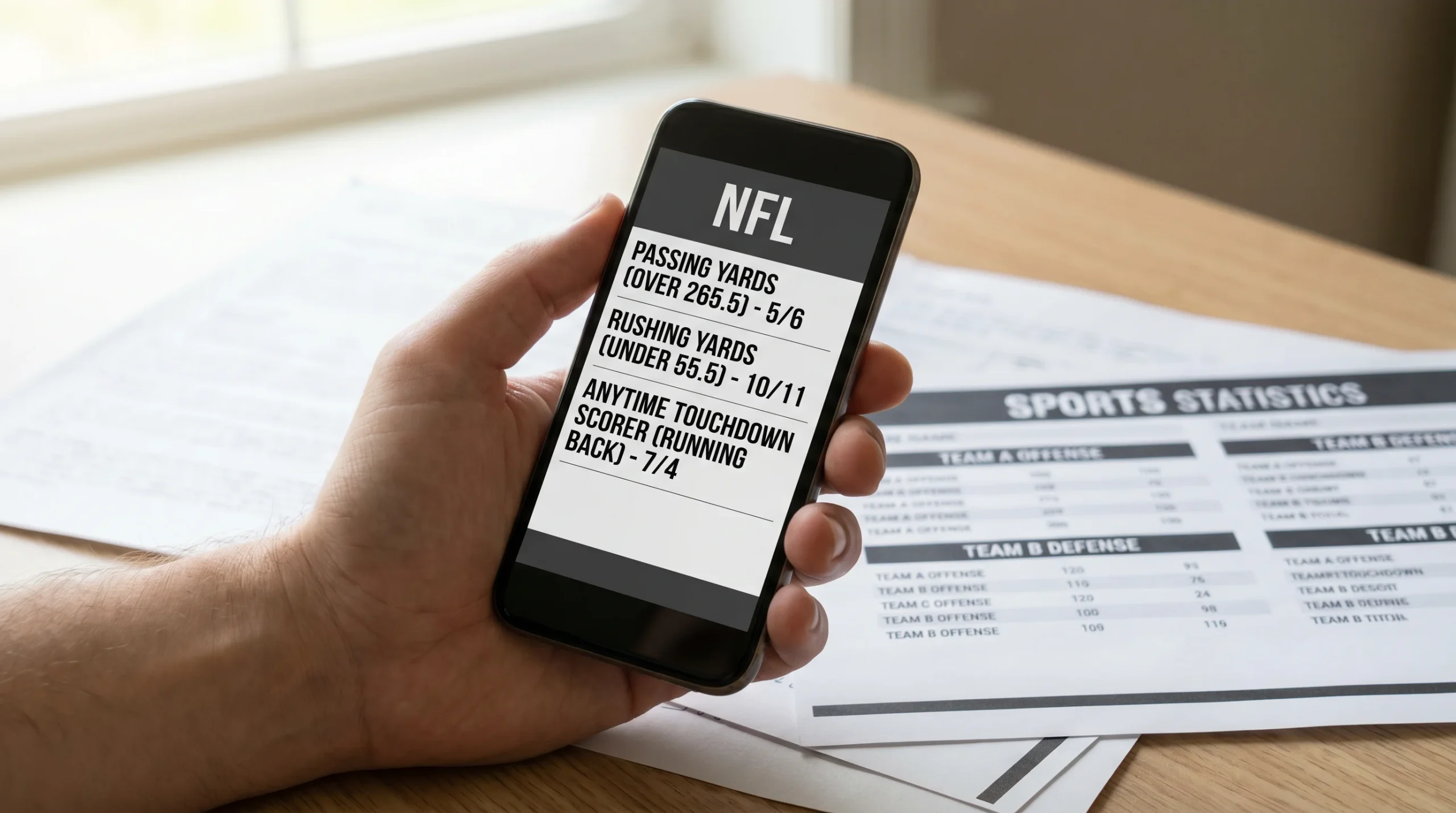
The first NFL bet I ever placed was a moneyline. The second was a spread. The thirty-seventh, somewhere around 2019, was an anytime touchdown scorer on a tight end I had spent three hours convincing myself was due. Player props are how most British punters genuinely engage with the NFL — not because the maths is better than the spread, which it usually is not, but because props turn the four-hour broadcast into a personal narrative about specific players. As one analytical brief on UK NFL betting noted, on a Premier League fixture the totals market is usually quiet. On an NFL fixture it’s frequently the most-traded line on the slip.
The same is true, several times over, for player props on the same NFL slip.
The product is fun. The product is also where the bookmaker margin is largest, where retail money is most concentrated, and where the most expensive mistakes get made. This guide is the working version of how I bet props — what I look at, what I ignore, and which structural traps the UK product is built around.
The props market in context
Player prop turnover has grown faster than any other segment of NFL betting over the past five years in the UK. The £596m of real-event online betting handle posted in the fourth quarter of 2024-25 includes a player-prop share that the books will not break out publicly, but the inference from comparable US markets and from the sheer number of prop markets posted per fixture is that roughly a quarter to a third of NFL revenue now flows through player props rather than game-line bets.
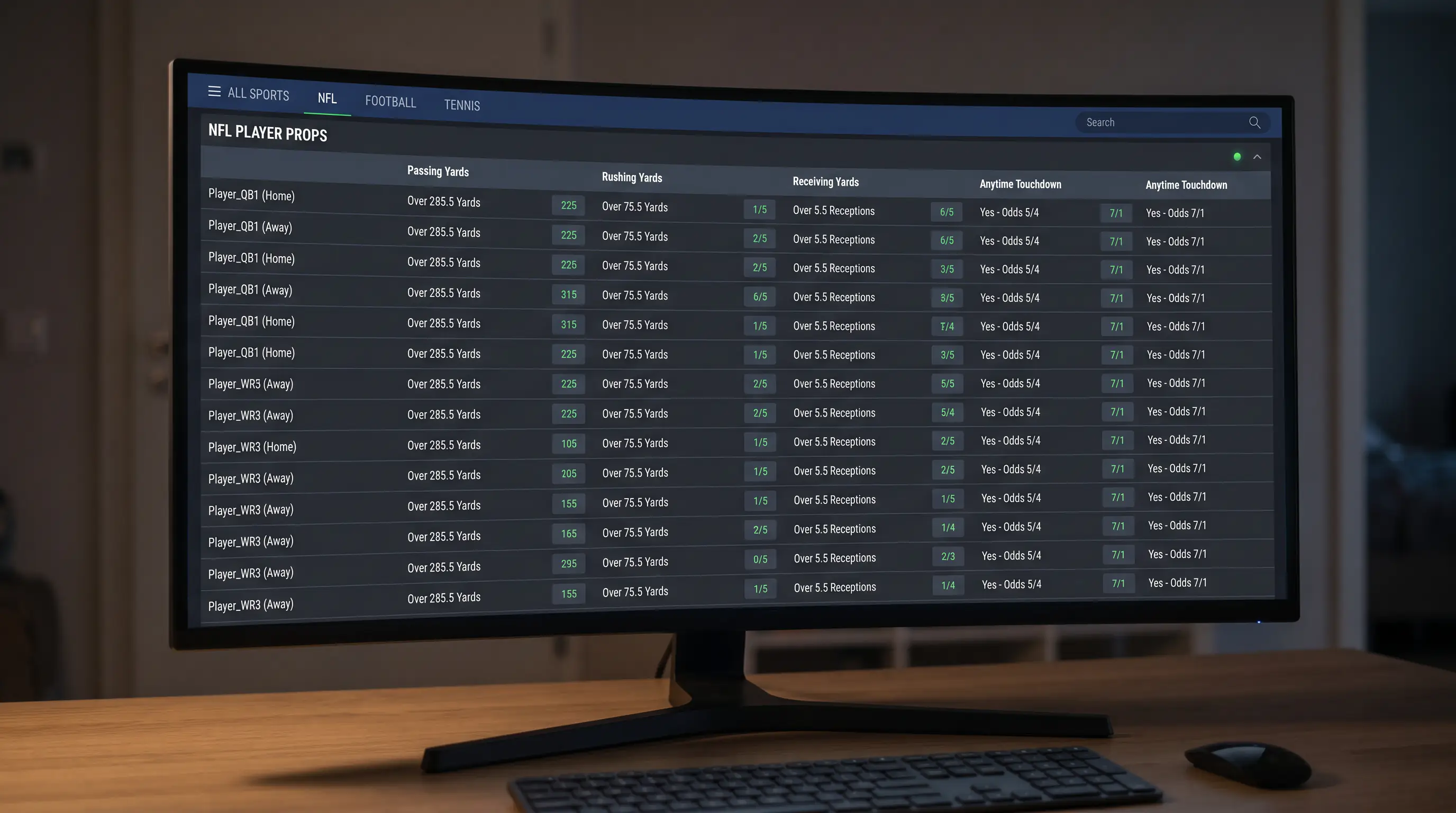
The structural reason is that props are individually small bets that aggregate into a meaningful book. The average UK punter who places a £20 spread bet will routinely place three or four £5 props alongside it. The book makes more money on the four small bets than on the single larger one, because the average margin per pound is much higher on props than on the spread.
The implication for a UK punter is that prop selection is the single biggest lever you have on long-term profitability after stake sizing. Picking the right spread is hard. Picking the right total is hard. Picking which prop to bet — out of the ninety on the board — and which to ignore is the single best way to compound or destroy a season’s results.
Passing props: the cleanest data, the heaviest juice
Quarterback passing yards is the most-traded player prop on every NFL Sunday, and the market that has the most calibrated pricing. The data is exhaustive — every quarterback has thirty-plus games of recent history, opponent pass defence is granular by down and distance, and the books have been pricing this market for fifteen years.

The line is usually set at a half-yard increment — say 274.5 yards for a starting quarterback in a favourable matchup. The over and under are both priced at 10/11 in the standard case. The variance in this market comes from two specific factors: game script and weather. A quarterback whose team is favoured by ten points will throw fewer yards in the fourth quarter than one whose team is trailing by ten, because the trailing team passes more out of necessity. Weather — particularly wind — knocks the over off harder than it knocks the under, because passing efficiency degrades faster than rushing efficiency in wind above 15mph.
The single best edge I have found in the passing yards market is the late-week injury overlay. If a team’s leading receiver is downgraded between Thursday and Saturday — even if he plays — the passing yards under is consistently mispriced. The book moves the line two or three yards. The actual production effect is closer to fifteen yards, because the quarterback has to redistribute targets and his completion percentage drops. The under on a wounded passing offence is the single most repeatable angle in the props market.
Passing touchdowns is a less reliable market because the variance is enormous. A quarterback throws between zero and five touchdowns in a typical game, and the line is set at 1.5 or 2.5. The over and under both have honest cases on any given Sunday. Bet this market only if you have a strong red-zone defensive matchup read, and otherwise leave it alone.
Rushing and receiving: the workload markets
Rushing yards and receiving yards markets are workload markets, which means they reward research into usage share more than research into talent. A running back averaging 22 carries a game is going to be priced higher than one averaging 14 carries, and the price gap will reflect the workload difference more than the per-carry efficiency difference.

The trap in rushing props is committee backfields. If a team splits carries between two backs, both will have artificially low individual lines, and the over will look tempting on both. The problem is that the split is variable game to game. Your “57.5 rushing yards” over hits comfortably when your back gets 14 carries and busts when he gets 9. The book is pricing the expected workload. Your job is to find weeks when the expected workload is mispriced — usually because the secondary back is injured, suspended, or in coaching disfavour.
Receiving yards is the cleaner of the two markets because target share is more stable than rushing share. A wide receiver running 28 routes a game runs 28 routes a game whether the script favours him or not. The variance comes from coverage matchups, particularly when an elite cornerback is assigned to a specific receiver in shadow coverage. A receiver shadowed by a top-five corner loses roughly 25% of his expected production. The book accounts for this but not always fully, particularly in the second tier of cornerbacks where the rating is less consensus.
The tight end receiving market is structurally the softest of the three skill-position prop markets, because tight end production is harder to model and the public has less information. Tight end overs in matchups where the opposing linebacker corps is below average have historically been one of the strongest single angles available in any NFL prop market.
Touchdown scorer markets
Anytime touchdown scorer is the most popular prop market on Super Bowl Sunday and one of the most popular on any regular-season Sunday in the UK. The product is intuitive — pick a player, will he score — and the prices are headline-friendly: 5/2 on a workhorse running back, 4/1 on a primary receiver, 12/1 on a backup running back. The maths is messier than the headline suggests.
Touchdown scorer pricing has three components: how often the team scores in total, what share of the team’s touchdowns the player has historically taken, and a market-wide overround that is materially heavier on this market than on the spread. The mechanics of anytime touchdown scorer pricing reward research into red-zone share specifically, because most touchdowns happen inside the twenty and red-zone usage diverges sharply from overall snap share.
The single most important fact about the anytime touchdown scorer market is that kickers are excluded — only field goals count, and the field-goal-scorer market is priced separately. This is not always obvious to new punters and it occasionally causes confusion when a team scores only via field goals and the “anytime” market settles as a loss across the board.
First touchdown scorer is a different beast. The price is structurally longer because you are betting both that the player scores and that he scores before anyone else does. The implied probabilities on first touchdown scorer markets carry overrounds north of 25% on most books, and the EV is genuinely poor unless you have a strong opening-script read.
Defensive and special teams props
The defensive prop market is the thinnest and most volatile section of the NFL prop board. Sacks, tackles, interceptions, and pass deflections all carry lines that the book has less data on than the offensive equivalents, and the markets are correspondingly less efficient. The flip side is that the public bets defensive props less, so the lines move less, which means an edge held into kickoff actually pays.
The most-traded defensive prop is anytime sack scorer on the headline pass rusher. The line is usually priced at 6/4 to 11/8, and the maths is roughly identical to the anytime touchdown scorer market — historical share of team sacks plus opponent pass-protection grade plus an overround tax. The opponent grade is the variable retail bettors most often ignore, and it is the single biggest input to the actual outcome.
Tackles props on inside linebackers are the sleepers of the defensive market. A linebacker playing 100% of defensive snaps against a team that runs the ball 30+ times a game is dramatically underpriced on the over more often than the market suggests. This is a research-rewarding market.
Special teams props — longest field goal, kicker points, punter punts — exist primarily as novelty lines and are not worth serious capital. The exception is the made-field-goals over on kickers facing teams with a strong red-zone defence, which is a coherent contrarian bet that pays out far more often than the price implies.
How a same-game multi actually works
The same-game multi — SGM, also called same-game parlay — is the bundle product that allows you to combine multiple bets on the same game into a single wager with a single combined price. It is the single fastest-growing betting product in UK NFL markets, and the single most heavily margined.
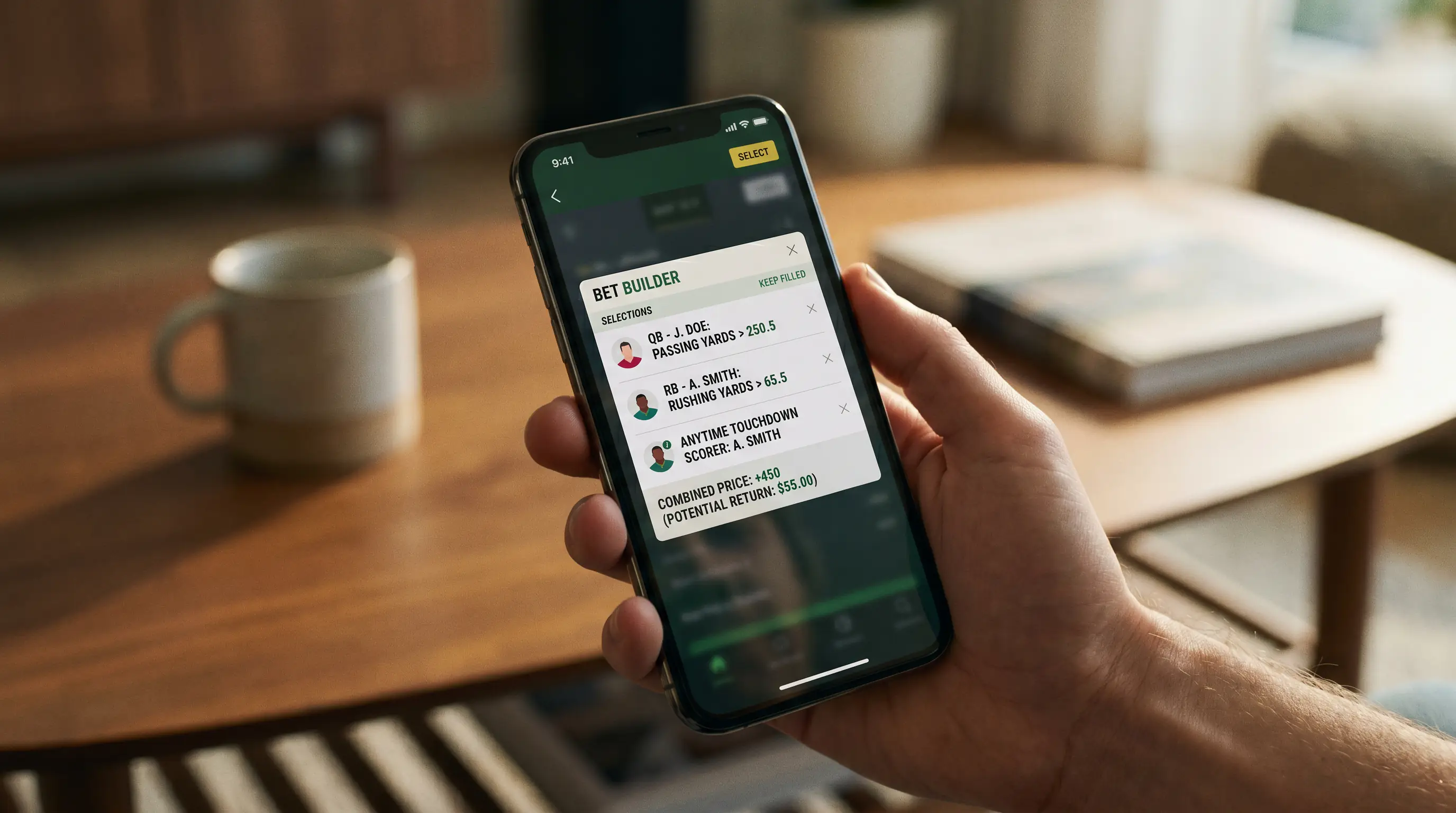
The mechanical version: pick three or four selections from the same game (spread, total, player props, all permitted in any combination), the book calculates a combined price, and you place one stake on the bundle. If all legs win, the combined price pays out. If any leg loses, the bet loses. The combined price is not a simple multiplication of the individual prices — because the legs correlate, the book adjusts the combined price downward to reflect that correlation.
The adjustment is the entire commercial point of the product. A naive parlay of three independent bets at 10/11 each would price at roughly 4.83 decimal. The same three bets bundled as an SGM in a UK book will typically price at 3.5 to 4.0, because the book has applied a “correlation tax” on top of the standard overround. That difference is the SGM margin. It is real, it is significant, and it is the reason SGMs are the most profitable product the books sell.
For UK punters, the SGM is a fun product that should be treated as a small-stake recreational bet rather than a serious wager. The expected value is structurally negative by a wider margin than any other product on the slip. If you must use it, build SGMs from negatively correlated legs (which the book sometimes does not detect and prices generously) rather than positively correlated ones (which the book always detects and prices punitively).
Correlation and what the book is really pricing
Correlation is the entire reason same-game multis exist as a separate product from a regular parlay. If you bet a quarterback to throw for over 275 yards AND his team to win, those two outcomes are not independent — the quarterback throwing for over 275 yards is meaningfully more likely if his team is winning, and vice versa. A regular parlay would price these as if they were independent, which would overpay you. The SGM product adjusts for the correlation, which underpays you relative to the naive parlay calculation.
Where this gets interesting is in the structure of the correlation adjustment. The book applies a flat correlation tax across most SGM constructions, but the actual correlation between any two legs varies wildly. A “quarterback over passing yards” and “leading receiver over receiving yards” are strongly positively correlated. A “quarterback over passing yards” and “running back over rushing yards” are weakly negatively correlated — if the QB has a big day, the team probably did not need to lean on the run.
The exploitable pattern is to build SGMs where the correlation between legs is negative or zero but the book prices them as if the correlation were positive. The book’s algorithm errs on the side of overpricing correlation, which means you get a slightly better combined price on negatively correlated legs than the fair maths would suggest. This is a thin edge but a real one, and it is the only way I have ever found to make SGMs play break-even rather than systematically negative.
Bet builder tools and the UK product
The bet builder is the UK version of the same-game multi, and it now ships as standard on every major UK sportsbook. The 13.5m active UK online gambling accounts averaged each month interact with bet builders more than with any other prop construction tool. The interface lets you click through markets, add legs to a bundle, and watch the price update in real time as the algorithm applies the correlation adjustment.
The product is engaging. It is also designed to maximise the number of legs you stack, because the book’s margin per pound rises with each leg added. A two-leg bet builder typically carries an overround of 6-8%. A four-leg bet builder is usually 12-16%. A six-leg bet builder is routinely 20-25%. The leg count is the margin lever.
If you are going to use a bet builder — and most British punters do — keep the leg count low. Two-leg and three-leg builds are reasonable products with reasonable margins. Four-leg builds are tolerable if every leg is independently a bet you would place on its own. Five-plus-leg builds are entertainment, not value.
The other detail worth knowing is that some legs grey out when combined with others. This is not a system glitch — it is the book preventing you from constructing a logically impossible bet (a quarterback to throw an interception AND have an under-1.5 interception total, for instance). The greying is also the book’s tell about which combinations it considers strongly correlated. If you can build a leg combination that the book allows but that you suspect should be greyed out, the price is probably mispriced in your favour.
Prop Protect and early payout offers
The “Prop Protect” branding — and its variants across UK books — refers to insurance products that refund a losing prop under specific conditions. The typical structure is: if your anytime touchdown scorer fails to score but the player records a substantial yardage day, the book refunds your stake. The conditions vary by operator but the principle is consistent.
These products are real, they do pay out, and they do not represent free value. The book is pricing the refund into the headline odds before you ever see them. A “Prop Protect” anytime touchdown scorer market will offer slightly shorter prices than the same market without the protection — typically 5-10% shorter on the favourite scorers, where the book expects the refund to be triggered rarely.
The honest assessment is that Prop Protect makes the betting experience less painful without making it more profitable. If you enjoy the product, use it on the headline scorer markets where the refund mechanics are clearest. If you are optimising for long-term EV, the cleanly priced version of the same market on a non-Prop-Protect book will usually offer the better headline number.
Where the props market traps the casual punter
The £7.8bn of UK remote gambling sector turnover in the year to March 2025 was generated, in part, by punters who systematically lost on player props at higher rates than on game lines. The mechanism is identical across every losing player I have ever looked at: too many props per slate, too many novelty markets, and too much same-game multi exposure relative to single bets.

The casual punter’s NFL Sunday looks like fifteen small prop bets across three games, with most of the stake going into two or three large same-game multis. The expected value of that slip is somewhere between -8% and -15%, depending on the specific markets. The same stake, redirected to four or five carefully chosen single prop bets on markets where the punter has done research, has an expected value closer to -3% to -5%. That is the gap between a hobby that loses you money slowly and a hobby that bleeds you out by January.
The discipline that wins is fewer bets, more research per bet, and a hard cap on novelty market exposure. Pick three props per slate you genuinely believe in. Place them as singles. Ignore the bet builder unless the construction is small and the legs are individually sound. That is the entire framework, and it is the framework that separates the long-term winners from the long-term funders of the £7.8bn.
Frequently asked questions
Why are anytime touchdown scorer odds so different across UK bookmakers?
Because the market is high-margin and the books compete on slightly different overround structures. A receiver priced at 11/4 at one book might be 5/2 at another — that is a real difference of about 5% implied probability. Line shopping the touchdown scorer market is the single highest-return activity in NFL prop betting, because the variance between books is wider than for any other major market type.
Can I combine player props from both teams into one same-game multi?
Yes, every major UK book allows cross-team legs in an SGM, with one important exception — directly contradictory outcomes are blocked (you cannot bet team A to win AND team B to score more points). Cross-team SGMs are sometimes the better-value construction, because the correlation between the two sides is weaker than within a single team’s offence, and the book’s correlation tax is therefore lower.
What does Prop Protect actually pay out and when?
It refunds your stake on a losing prop if a defined performance threshold is met. The most common version is the anytime touchdown scorer market — if your player fails to score but records, say, 100 yards from scrimmage, you get your stake back. The threshold varies by operator, the refund is typically as a free bet rather than cash, and the cost is baked into the underlying odds, which are shorter than the unprotected market would offer.
What the props market rewards
The props market rewards three things consistently: usage research, line shopping, and stake discipline. Everything else is theatre. The book has built a product that is genuinely fun to bet, displayed on a slip that is engineered to keep you adding legs, with margins that pay for the entertainment. None of that is a reason to avoid prop betting. It is a reason to bet props the way the sharps bet them — fewer selections, more thought per selection, and complete refusal to be drawn into the deeper margin products unless you are explicitly buying entertainment rather than value. The props market on the NFL is the most interesting market in British sports betting. Treat it with the same arithmetic you would bring to any other market, and it stops being the most expensive one.
