
 Available in US
Content
- The Sunday morning when London changes the price
- How the London series got here
- What the 2025 series actually told us
- The UK fanbase is the underlying engine
- Wembley versus Tottenham: two stadiums, two betting climates
- Time zones and the Sunday morning lines
- Attendance, ticket demand and market depth
- Jet lag, scheduling and handicapping the travel
- The London markets that actually trade
- Franchise relocation and the long London bet
- The 2026 season outlook
- Frequently asked questions
- What London changes about an NFL Sunday
The Sunday morning when London changes the price
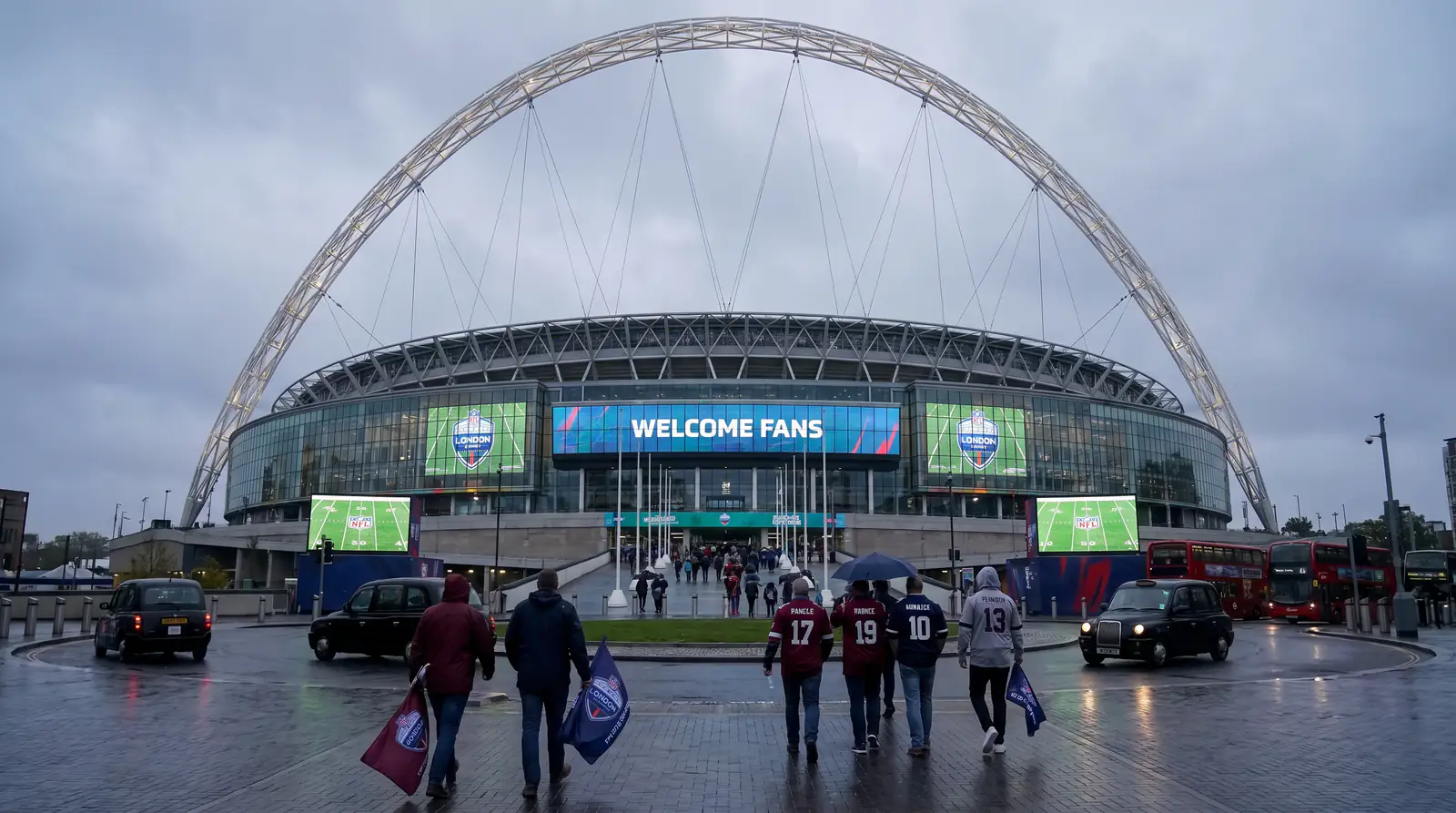
I have a working theory about NFL London Games that I have never been able to disprove on a season’s worth of lines: the moment kickoff moves from 13:00 Eastern to 14:30 in London, the betting market starts behaving like a different animal. Spreads tighten in odd places. Totals drift later than they should. Same-game multis get priced as if every leg correlates more strongly than usual, because UK retail money is piling in on the local team rather than the better team. The 86,651 supporters who packed Wembley for Jaguars-Patriots in October 2024 set a London attendance record, and every one of them carries a smartphone with a sportsbook open in a tab. That is the structural reason London lines move differently from a Buffalo home game.
More than six million people in the UK watched London Games in 2025 across TV and streaming — a record for the international series. That viewership feeds the betting handle, and the betting handle reshapes the line. This guide is about reading those distortions instead of falling for them.
How the London series got here
The International Series started in 2007 with a single game — Giants versus Dolphins at Wembley — and the working assumption inside the league office at the time was that it might run for two or three years before fan fatigue set in. Thirty-nine regular-season games later, that assumption looks quaint. London has hosted more NFL games than any non-American city in the league’s history, and the schedule has expanded to three venues across the season: Wembley, Tottenham Hotspur Stadium, and on rotation, a third game depending on team availability.
The early years priced the games like neutral-site curiosities. The home team got a token half-point of edge for being “the home team,” and the road team was priced as if they were on a slightly inconvenient road trip. That was wrong, and the sharper books figured it out by the early 2010s. The home team in a London game is not really at home — they slept in a hotel, they trained at a temporary facility, and they faced the same five-time-zone challenge as the visitors. Modern London lines correctly price this as a neutral-site game with two travelling teams, and the half-point home edge has effectively been removed.
What has not been priced out, in my reading of the closing lines, is the UK fan tax on the Jaguars. Whenever the Jaguars appear at Wembley, the spread shaves about a point off what their road number would be at a US venue. That is a quantifiable bias, and it is the most reliable angle anyone betting London Games regularly has identified over the past decade.
What the 2025 series actually told us
The 2025 London series was the moment the betting market and the marketing finally agreed on something. Six million UK viewers, three sold-out games, and a level of in-stadium engagement that pushed Wembley and Tottenham into territory that even the most optimistic NFL UK projections of 2015 would not have anticipated. As one London-based editorial put it, the 2025 season marked a major leap forward. London’s sporting events did not just involve the games. They were important games with globally attention. The betting markets also matured.

The maturation showed up in two specific places. First, the opening spreads on London Games came in tighter than ever before — within half a point of the Vegas openers in most cases, where ten years ago they routinely diverged by a full point. Second, the prop markets on London Games expanded materially. Where a 2018 Wembley game might have had thirty player props on the board, a 2025 Tottenham game routinely had ninety, including bespoke “first scoring drive” and “longest play” markets that mirrored what you would find on a US Sunday Night Football slate.
For a UK punter, that maturation cuts both ways. The price is sharper than it used to be, which means the easy edges from the early International Series years are gone. But the depth of the market is genuinely better, which means there are more leaves to flip looking for the ones that are mispriced.
The UK fanbase is the underlying engine
You cannot understand London Game betting without understanding the audience behind it. The NFL counts 14.3m fans in Britain — almost one in five adults. YouGov data puts the share of Britons expressing interest in the NFL at 9%, which is 2.25 times the share who say the same about the NBA, MLB or NHL. The notion that American football is a niche curiosity in the UK has not been true for at least a decade, and the betting market reflects that.

The geography of UK fandom matters for prop markets in ways that are not obvious until you map it. A Smart Betting Guide study found that Croydon led all UK cities for NFL-related search intensity at 242 queries per 100,000 residents — 198.8% above the national average of 81. London, Birmingham, Manchester and the south-east coast cluster all post well above national average. The midlands and the north-east are catching up but still trail. The practical implication is that London Game retail handle is heavily weighted toward London-resident fans, and the prop markets that move fastest are the ones that get shared across London-based social channels in the forty minutes before kickoff.
If you find yourself wondering why an anytime touchdown scorer on a popular skill-position player went from 6/4 to 5/6 between 13:00 and 14:00 on a Wembley Sunday, the answer is usually that a London-based group chat decided he was the bet of the day at exactly 13:20. That is not a fundamental price move. That is retail money in a concentrated geography hitting a thin market. The reverse position — fading the player at the shorter price — is sometimes the entire bet.
Wembley versus Tottenham: two stadiums, two betting climates
The two London venues are not interchangeable, and the betting markets do not treat them as such. Wembley is the larger of the two — capacity around 90,000 against Tottenham’s 62,000 NFL configuration — and that capacity gap shows up in totals pricing. Wembley games carry a slightly elevated total because the stadium produces more crowd noise, more visiting-team penalty risk, and historically a marginally higher scoring rate.

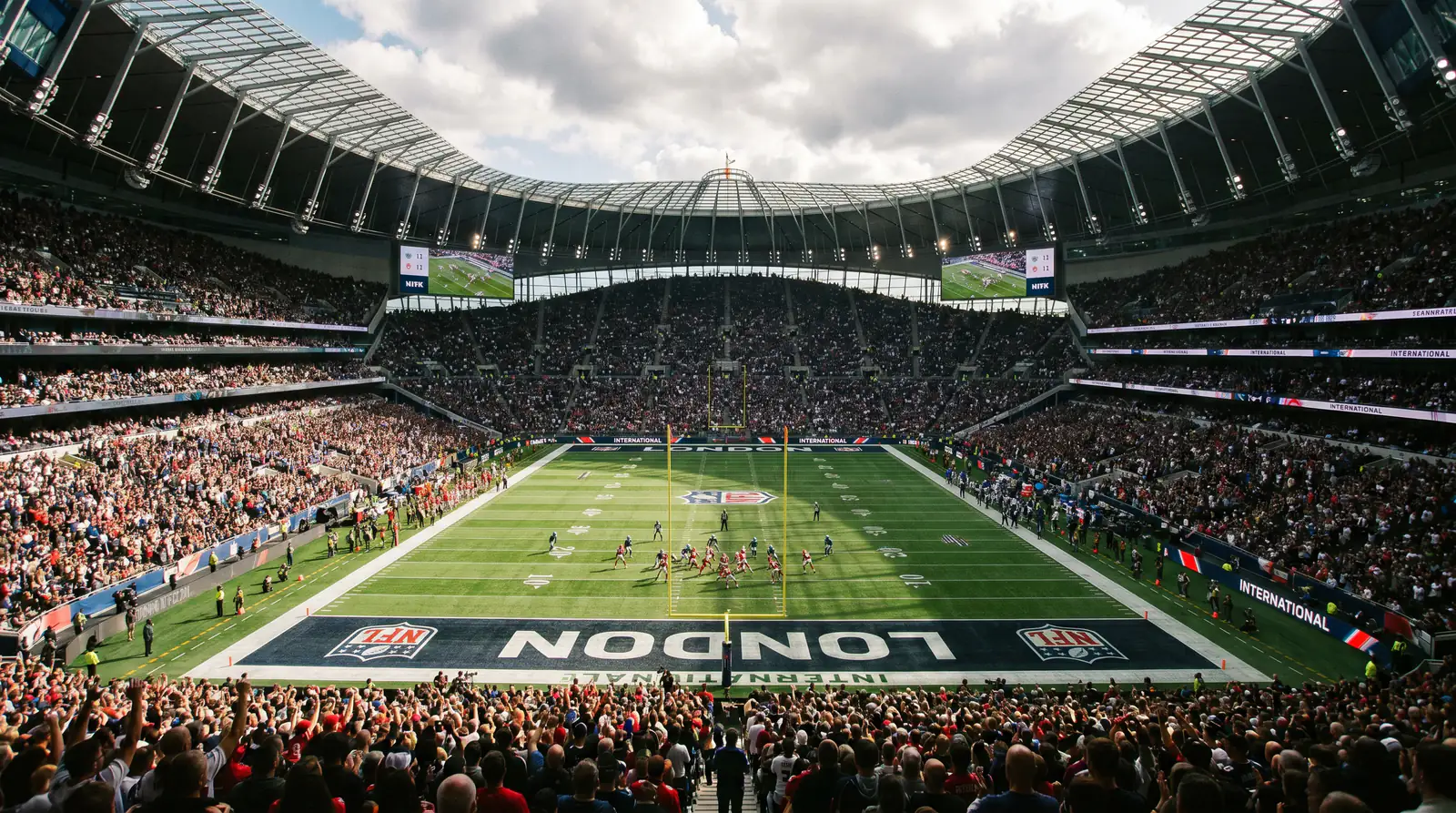
Tottenham, by contrast, was built with American football in mind. The dual-purpose pitch system, the visiting-team locker room layout, the sightlines — all of it was engineered around an NFL fixture as a primary use case rather than an annual visit. The result is a venue that plays more like a US dome than a converted soccer ground, and the totals market reflects that. Tottenham games run hotter for tempo and lower for variance.
For spread bettors, the venue choice has a smaller but real effect. Wembley’s larger crowd amplifies home-team bias in the UK fan vote when the Jaguars play there, which is why the Jaguars-at-Wembley line is consistently a point shorter than the Jaguars-at-Tottenham line for the same opponent. The Jaguars’ Wembley pricing pattern is the single most exploitable structural quirk in the entire London series, and it has held up across multiple seasons. If you are betting a London Game and the Jaguars are involved, check the venue first.
For prop bettors, the Tottenham markets tend to be a touch sharper, because the venue’s predictability removes the weather and surface variance that Wembley occasionally injects into outcomes. A skill-position over at Tottenham is generally a cleaner read than the same number at Wembley, where wind off the Wembley arch has been known to do strange things to passing yards.
Time zones and the Sunday morning lines
The most underrated detail about London Games for British bettors is that they kick off at 14:30 local time on a Sunday, which means the line is fully baked when a UK punter wakes up. That is the opposite of every other NFL Sunday, where the 18:00 kickoffs in the US correspond to a 23:00 GMT start and a UK punter has all day to shop prices. London Games compress the betting window dramatically.
The practical consequence is that London Game lines move less between Friday and kickoff than US-venue games do, because there is less time for late money and late news to land. The Saturday market is the meaningful one. By 22:00 GMT on Saturday, the price you are getting is essentially the closing line plus or minus a few minor wobbles. If you have an angle on a London Game, you need it placed before you go to bed on Saturday night.
The flip side is that the in-play market on a London Game runs during prime UK Sunday afternoon hours, which means it sees more retail handle than any other NFL fixture all season. Live totals and live spreads on London Games are noticeably softer than on US-venue games, because the algorithm is being pushed by a wave of UK retail money that the model is not fully calibrated for. The sharpest in-play opportunity of the NFL season, in my experience, is the second-half line on a Wembley or Tottenham game when the score is tighter than the first-half implied total.
Attendance, ticket demand and market depth
The 86,651 figure at Wembley for Jaguars-Patriots is not just a stadium record — it is a signal about market depth. Capacity-pushing crowds correlate with deeper prop markets, more aggressive bookmaker promotions, and broader same-game multi inventories. UK books invest more market-making attention in fixtures they expect to draw retail handle, and the demand signal flows directly from ticket sales.
What this means in practice is that the props market on a Wembley fixture between two popular American teams will be roughly twice as deep as the props market on a US-venue Sunday afternoon game between the same two teams. There will be more individual player markets, more bespoke crossover bets, and more aggressive boosts. The depth is the opportunity. The risk is that the boosts are almost always more juiced than they look, and the bespoke markets are almost always priced with a heavier overround than the standard player lines.
A sensible heuristic on London Games is to bet the standard markets — spread, total, moneyline, basic player props — and ignore the bespoke London-themed boosts unless you have specifically priced them out. The boost is a marketing tool. The standard market is the actual book.
Jet lag, scheduling and handicapping the travel
The single most-discussed handicapping factor on London Games is travel fatigue, and the discussion is almost always overdone. The data on London Games over the past decade does not support the idea that the team flying further loses more often. What it does support is the idea that teams playing the week before a London Game perform worse than teams playing in a bye, by a margin that is materially larger than the same gap on US-venue games.

The reason is the recovery window. A team that played a physical Sunday-Sunday-Sunday triple culminating in London has had five days less recovery than a team that played, took a bye, and travelled. That gap shows up in second-half performance specifically — fourth-quarter rushing yards drop, late-game pass-rush pressure rates fall, and red-zone conversion declines. If you are looking for an angle on a London Game, the schedule density of the two teams in the prior fortnight is a better predictor than which side of the Atlantic they fly from.
The other underdiscussed travel factor is the third game of a London series. Teams playing the third Sunday in a row at a London venue — even though they are different teams — face a less prepared host venue than the first or second game. Field condition, locker room setup, and broadcast infrastructure all degrade by week three. The total tends to come in higher than the first two games, and the under has historically been the contrarian play.
The London markets that actually trade
The popular markets on a London Game in the UK are the spread, total, moneyline, anytime touchdown scorer, passing yards on the lead quarterback, and the same-game multi bundle. That is roughly 80% of the handle. The remaining 20% splits across the bespoke markets and prop building tools, and that is where most of the bookmaker margin lives.
If you are a British punter who watches every game live, the live first scoring play and live next score markets are unusually deep on London Games, because the broadcast keeps cutting back to UK fan reactions and the market follows the engagement. They are also unusually well-priced, in the sense that you can find genuine value on a Wembley first scoring play that you would never find on the same market for a US-venue game.
If you are a casual punter, the build-a-bet tools on a London Game offer the most fan-friendly product the books make all season, and they are also the worst expected-value bet on the slip. The overround on a four-leg London-themed same-game multi is routinely above 15%. Build it for fun, stake small, and do not pretend it is a serious wager.
Franchise relocation and the long London bet
The question that hovers over every London Game is whether one of these visits will eventually become a permanent residency. Roger Goodell has been on the record about this for several years. There’s no question that London could support, not just one franchise, I think two franchises. I really believe that. That’s from a fan perspective, from a commercial standpoint, from a media standpoint,
he said in an interview repeated across NFL UK media. More recently, he doubled down: I would say that the markets outside the U.S. are very, very attractive. There are markets that could certainly support a team.
The betting implications of an eventual London franchise are enormous and almost entirely unpriced in current markets. A permanent London team would shift the international series calculus, change the Jaguars’ identity, and create a structural change in UK NFL betting handle that the current sportsbook ecosystem is not built for. None of that is on any board. The futures market on “first NFL franchise to relocate to London” exists at a few specialist books, but it is illiquid, expensive, and not worth your money.
What is worth your money is the recognition that every London fixture is, in some sense, a longitudinal data point in the league’s evaluation of the market. The crowd response, the broadcast numbers, the commercial uptake — all of it feeds the eventual decision. Treat the London series as a story you are watching unfold, not a market you are about to crack. The crack, if it comes, will come over years.
The 2026 season outlook
The NFL played seven international games in 2025 — up from five in 2024 — with premieres in Madrid, Dublin and Berlin alongside the established London slots. The 2026 schedule is expected to follow a similar pattern, with three London games anchoring the international series and a small number of additional European fixtures rotating into the calendar.

For UK bettors specifically, the 2026 London window will most likely span late September through early November, with at least one Wembley fixture and at least one Tottenham fixture. The third London game, when it appears, has historically been the lowest-attendance of the three and the softest-traded — which makes it the most interesting from a value perspective.
The fixture announcement typically lands in mid-May, and the markets open within forty-eight hours of confirmation. The opening spreads are usually the sharpest London Game lines you will see all year, because the books have had five months to model them. By the time kickoff arrives in October, the price has been moved by retail flow as much as by news. If you have a view, get your money down in the first forty-eight hours of the market opening.
Frequently asked questions
Do London Games attract sharper or softer NFL betting lines?
The opening lines on London Games are now within half a point of the Vegas openers, which is sharper than ever before. What remains soft is the in-play market during UK afternoon hours, where retail handle pushes live spreads and totals away from where a model would put them. The pre-match line is sharp. The live line is the opportunity.
How does jet lag factor into NFL London Games handicapping?
Less than most people think. The bigger handicapping factor is schedule density in the prior fortnight. A team coming off a bye consistently outperforms a team coming off a Sunday-Sunday-Sunday run, by a margin larger than on US-venue games. Fly distance matters less than recovery window.
How much of the Jaguars’ Wembley price comes from UK ticket demand rather than on-field form?
Roughly one point of spread. Across multiple seasons, the Jaguars at Wembley have priced consistently shorter than their road number at a US venue against the same opponent, and the differential survives controls for opponent quality. The UK fan vote is a quantifiable price input, and the contrarian position on Jaguars-as-favourites at Wembley has historically been a profitable one.
What London changes about an NFL Sunday
Every other NFL Sunday is a US-venue Sunday with a UK punter watching from a sofa. London Sundays invert that relationship. The fixture comes to you. The line is shaped by your neighbours. The in-play market runs through your afternoon rather than your night. That inversion is what makes the London series both the most fun NFL betting weekend of the year and the most distorted. Bet the structural angles — the Jaguars fan tax, the schedule density edge, the live second-half value — and ignore the boosts and the bespoke novelty markets. The depth is real. The juice on the bespoke product is real too.
