
 Available in US
Content

The Slip That Made My Sunday and Cost My Month
A five-fold I built one Sunday in October took two minutes to construct and netted me £340 on a £20 stake. I told the story for weeks. What I did not tell anyone, because I had not yet done the maths, was that I had been placing similar accas for two months and the five-fold was the first one that cashed. Net for the eight-week experiment was minus £85. The afternoon felt like winning. The spreadsheet said otherwise.
That is the accumulator in microcosm. It is the most popular product in UK NFL betting outside the moneyline, it is the one British punters know best from football betting, and it is the one where the maths is most ruthlessly stacked against the punter. UK gambling industry GGY in Q4 2025 reached £4.5 billion including lotteries and £3.3 billion without, and a meaningful slice of that money flows through multi-leg products that look like value and are not.

The Maths You Have to Do Once
An acca multiplies the prices of each leg together. Four legs at 10/11 each – call that decimal 1.91 – produce a combined price of roughly 13.3, which the bookmaker rounds to 12/1 in fractional. That looks generous on a £10 stake. It is not generous.
Each leg at 1.91 implies a true probability of 50% before vig and roughly 52% after. Four independent 50% legs hit together 6.25% of the time. Your acca pays 12/1, meaning it needs to hit 1-in-13 – that is 7.7% of the time – to break even. The 6.25% true probability against a 7.7% break-even rate means you lose roughly 19% of every pound staked on a four-fold of this shape, every time, regardless of which teams you back.
The vig compounds. Each leg of a UK acca carries the bookmaker’s full margin built in, and multiplying four legs multiplies four sets of margin. The deeper the acca, the worse the expected value gets. Six-folds of even-money legs lose roughly 30% of stake in long-run EV. Eight-folds lose more than 40%. Nobody tells you this when you scroll through the daily acca tips.

Correlation, And Why Books Care
The acca maths above assumes the legs are independent. If your four legs are all moneylines on different games, they roughly are. If your four legs are all spreads on Sunday afternoon, they roughly are. If two of your legs are connected – say, the Bills moneyline and the Bills over the team total – they are not, and the bookmaker has already adjusted for that.
UK books treat any two legs from the same fixture as correlated and either disallow the combination on a traditional acca or shunt you into a same-game multi product with a correlation-adjusted price. The adjusted price is shorter than the naive multiplication because the book knows correlated legs hit together more often than the maths suggests. The adjustment is roughly fair on average but rarely generous. Stacking correlated legs is not the easy edge punters sometimes assume – the books have priced it.

Boost Offers and Where the Trap Is
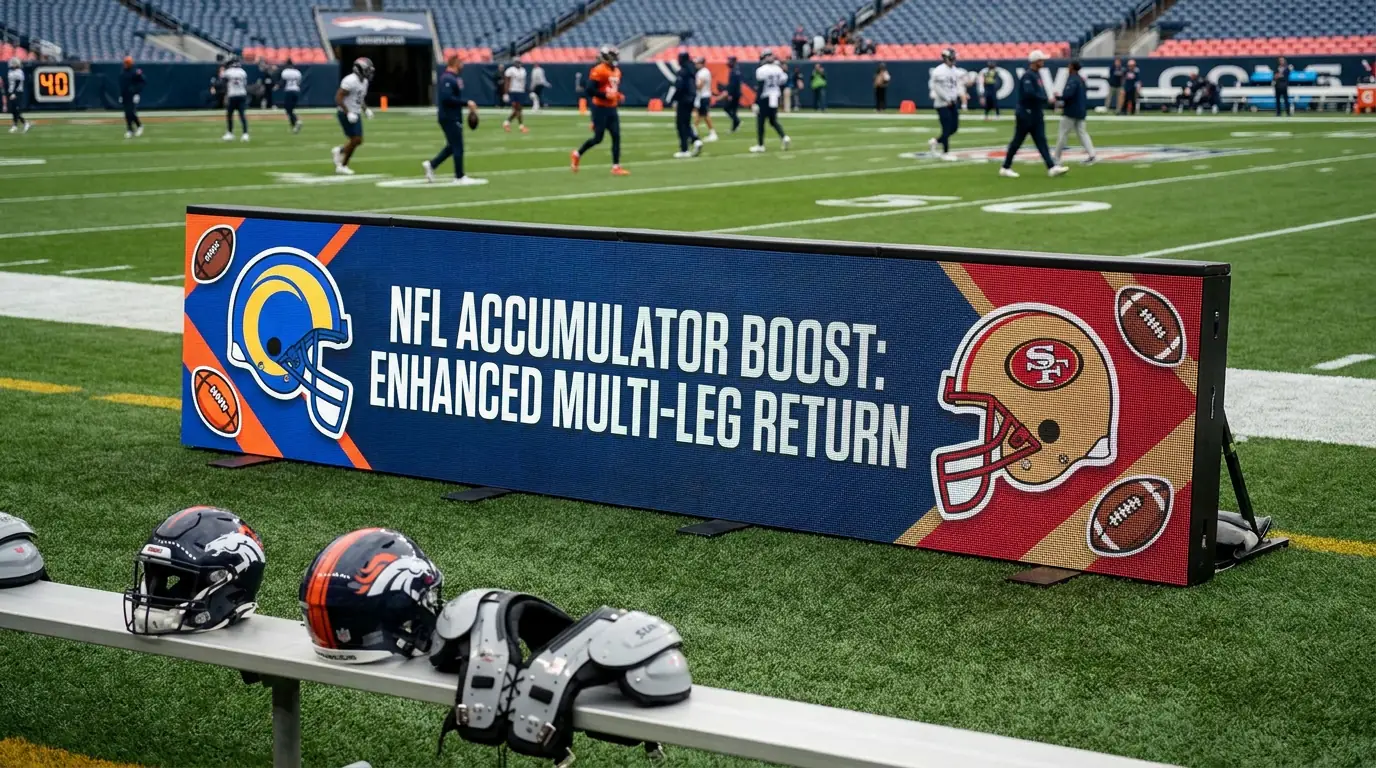
Acca boosts are the UK market’s most aggressive customer-retention tool. Hit a five-fold, get 25% extra. Hit a six-fold, get 50%. Hit a seven-fold, get a 100% bonus. The numbers look like free money. They are not free money. They are calibrated.
A 25% boost on a 12/1 acca raises your effective return from 13.0 to 16.25 in decimal terms. At a 6.25% true probability of hitting, that means your break-even shifts from 7.7% to 6.15%. You have moved from losing 19% per pound staked to losing 2% per pound staked. The boost has not made the bet profitable. It has made it slightly less unprofitable. Books offer boosts because they know retail punters will see the headline number and not run the maths underneath it.
The only boost worth taking is one that genuinely tips a specific bet into positive EV. That requires the boost itself to exceed the vig drag on your particular legs. Across UK acca boosts, less than 10% of available offers clear that bar after factoring leg-level vig. Treat boosts as a curiosity rather than a strategy.
Acca Insurance and the Reality of It
Acca insurance – typically a free bet or stake refund if one leg of your acca loses – is sold as the safety net that makes multi-leg betting tolerable. The maths is less reassuring. A free bet refund is typically worth 70-75% of cash value at long-run conversion rates, because you cannot withdraw it and you have to bet it through at the bookmaker’s prices to extract any value.
On a five-fold where four legs hit and one loses, your insurance pays you a free bet worth roughly 75% of what you staked. On a five-fold where two legs lose, you get nothing. The frequency of “exactly one loser” outcomes is higher than the frequency of “two or more losers” outcomes for accas built on short-priced legs, which is why books happily offer the insurance – it pays out less often than the headline suggests and pays out less than face value when it does.
The insurance is genuinely valuable in one specific case: a long-shot acca where multiple legs are priced above 2/1. Those accas almost never cash, almost never lose exactly one leg, and the insurance has effectively no expected value. In other words, the place where insurance might help is the place it almost never triggers.

A Five-Fold I Would Actually Build
If I had to build a single five-fold on a Sunday slate, here is the shape I would use. Three moneyline legs at 4/9 to 4/6, all road favourites of seven points or more on the spread, against opponents with poor home defensive records. Two spread legs at 10/11 each, both on home underdogs of 3 to 6 points where I have a specific read on the matchup. Combined price comes out around 11/1 or 12/1 depending on the exact prices.
The structure works because the moneyline legs at short prices anchor the acca with realistically high hit rates, while the spread legs provide the upside. Hit rate on a clean five-fold of this shape lands roughly 12-14% based on my records. The 11/1 price needs an 8.3% hit rate to break even, so this construction is approximately neutral EV before any boost. With a 20% acca boost it tips into modest positive EV. Without the boost, it is a £5 entertainment bet, not a serious wager.
The point is not that this exact structure is a print. The point is that any acca worth placing should survive a back-of-envelope EV check before you press confirm. If you cannot quickly justify why the combined price beats the multiplied implied probabilities, you are not building a bet – you are buying a lottery ticket priced as if it were one.
If you want to read about how to attack welcome offers without falling for the same headline-number trap, the comparison of UK NFL welcome offers and what they actually cost works through the EV maths in the same shape as the acca maths above.
Are NFL accas profitable in the long run for UK punters?
The structural answer is no. Each leg carries the bookmaker’s full margin and multiplying legs multiplies the margin. A typical four-fold of even-money legs loses around 19% of stake in long-run expected value before boosts, and deeper accas lose more. Specific edge cases exist – boosted offers with the right correlation profile, or accas built around a strong directional read on a slate – but the default expectation should be that accas are entertainment, not investment.
What is acca insurance and when does it pay?
Acca insurance refunds your stake, usually as a free bet, when exactly one leg of a qualifying acca loses. It pays out less often than the headline suggests and the refund value is typically 70-75% of face value once you account for free-bet conversion mechanics. It is genuinely useful only on accas built around short-priced legs, where the ‘exactly one loser’ outcome is the most common loss pattern.
