
 Available in US
Why the NFL slip looks nothing like the football slip
The first NFL bet I ever placed in this country was a moneyline on the Steelers at minus-eight, in a high-street shop, on a slip the cashier had to triple-check because she had never seen American odds before. Today my phone buzzes with line-movement alerts before kickoff, the same shop carries dedicated NFL boards every Sunday, and the punter standing next to me at the counter is just as likely to be reading a Bills injury report as a Premier League team sheet. Something has shifted, and the betting slip is the receipt.
The NFL has built a serious British audience while most people were not watching. The league counts 14.3 million fans in the United Kingdom — close to one in five adults — and YouGov has the headline number at 9 per cent of Britons describing themselves as interested in American football, more than double the figure for the NBA, MLB or NHL. Eight per cent of British adults placed an online sports or horse-racing bet in any given four-week window last autumn. The Venn diagram of those two groups is the audience this guide is written for.
14.3 million
NFL fans in the United Kingdom
9%
of British adults interested in the NFL
£7.8 billion
UK remote-sector gross gambling yield, year to March 2025
£596 million
quarterly online real-event betting GGY
This is a working guide rather than a promotional one. I have spent a decade modelling spreads, totals and player props for the British market, and the questions I get from new NFL punters are always the same: how do American odds map onto fractions, why is the total such a serious market here when it is barely a sideshow in Premier League football, where does the bookmaker's margin actually live, and what does "Prop Protect" mean. We will work through all of that, with the regulation, the responsible-gambling rails and the seasonal calendar laid out so you know where you are at any point in the year. There are no rankings of "best" bookmakers below. There are numbers, mechanics and the kind of context that turns a coupon into a considered position.
What to take from this guide before kickoff
- NFL betting is fully legal in the UK through UKGC-licensed operators; the market sits inside a £7.8bn remote sector with 13.5 million average monthly active accounts.
- The three core markets are the spread, the moneyline and the total — and the total is taken far more seriously on an NFL fixture than on a Premier League one.
- British books quote NFL in fractions and decimals; converting from American odds is a thirty-second skill.
- The 2025 statutory levy charges online operators 1.1% of GGY toward harm-prevention research, treatment and education.
- Bankroll discipline, line shopping and a working understanding of vig matter more than any tipster.
The UK betting market the NFL has dropped into
A trader I know at one of the larger British books told me last winter that his busiest single hour on a Sunday is no longer the Premier League 4pm kickoffs — it is the NFL early window at 6pm UK time, when the slate opens and the bet-builder traffic spikes so hard the dashboard turns red.

The British gambling market that has absorbed this American sport is enormous and tightly supervised. Gross gambling yield from the remote casino, betting and bingo sector reached £7.8 billion in the year to March 2025, up 13.1 per cent year on year. Inside that, the first quarter of 2025 alone delivered £1.45 billion of online GGY across an average of 13.5 million active accounts per month. Online real-event betting, which is the bucket the NFL sits in, generated £596 million in the most recent published quarter, growing 5 per cent year on year. Those numbers explain why bookmaker investment in NFL trading and bet-builder tooling has accelerated so visibly since the pandemic.
The structural context — UK punters are betting online, on mobile, and in higher volumes than the high-street comparison would suggest. The NFL is one of the few sports where mobile-first usage maps cleanly onto natural fan behaviour: the games arrive in evening UK hours, the broadcasts are on streaming platforms, and the slip lives on the same phone as the stream.
What makes American football a different proposition for the British trader is the shape of the markets themselves. As one analytical brief I keep on my desk puts it, "Most UK punters arriving at NFL from football are surprised that the totals number is a real bet rather than a sideshow. On a Premier League fixture the totals market is usually quiet. On an NFL fixture it's frequently the most-traded line on the slip." The cultural defaults are wrong. You cannot pick up an NFL coupon and apply Premier League instincts to it.
Three structural facts shape every bet you place. First, every NFL game has a spread, a moneyline and a total quoted with rough symmetry. Second, the league's scoring distribution is bimodal around three- and seven-point margins, which is why the spread market does not look like a football handicap. Third, the bookmaker's margin is built into both sides of every two-way market in a way that is mechanically transparent once you learn to read it.
The UK industry today operates under a statutory levy that came into force in April 2025 and is undergoing the most significant overhaul of advertising and affordability rules in two decades. NFL betting sits inside all of that. It is a serious product in a serious market, and you should treat it that way from your first slip onwards.
How big the British NFL audience actually is
Ask a London cabbie if he watches NFL and the answer is no, of course. Ask a 28-year-old Croydon resident the same question and the data says he is more likely to be searching for the league online than almost anyone else in the country. A Smart Betting Guide study last year found Croydon led every UK city for NFL search intensity at 242 queries per 100,000 residents, nearly 200 per cent above the national average of 81.
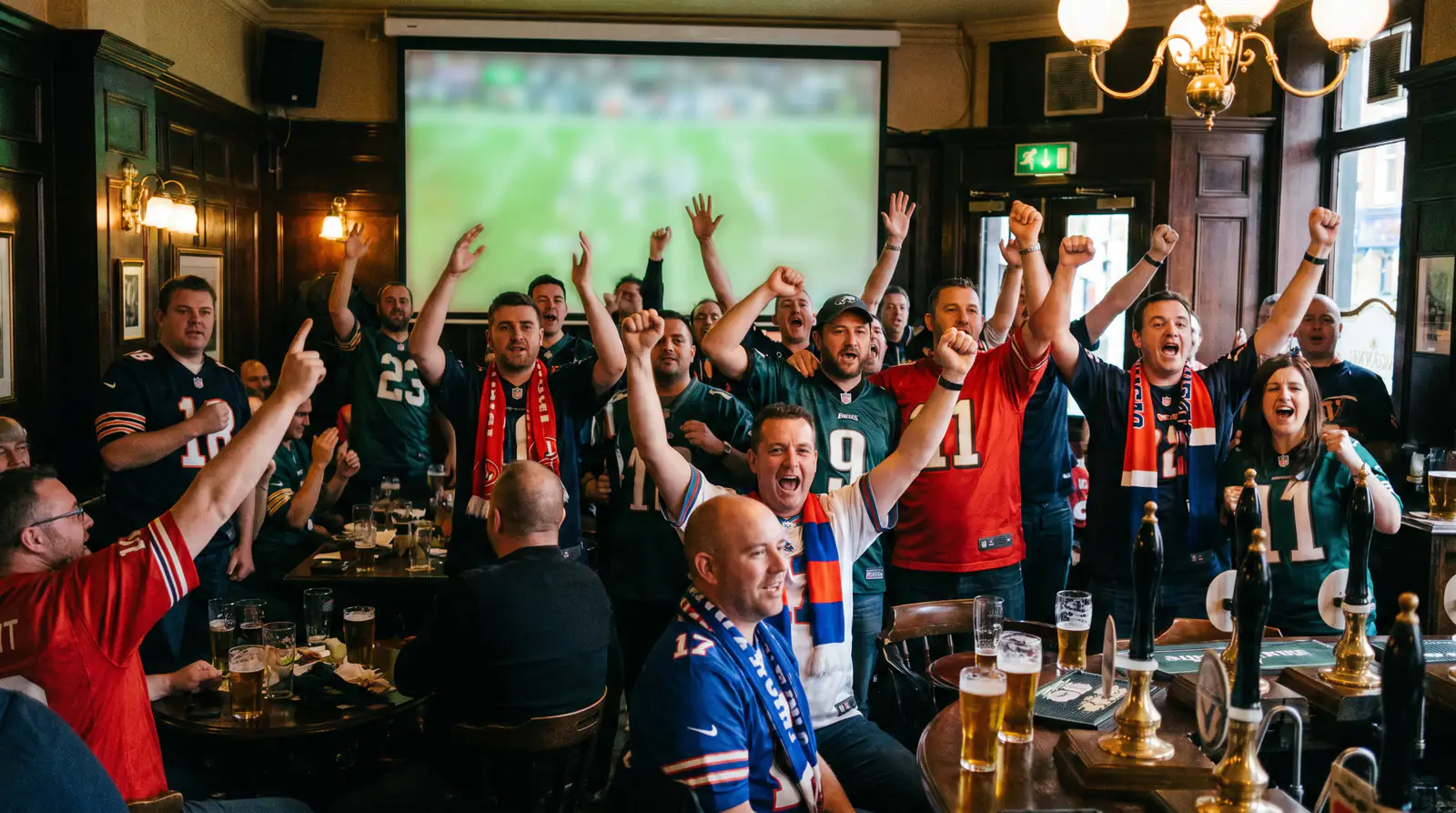
The headline numbers are striking when you line them up. The NFL puts the UK fanbase at 14.3 million people. Henry Hodgson, who runs NFL UK, frames it slightly differently — "over 15 million fans" and "over 100,000 young people" playing flag football across the country. YouGov's tracking has 9 per cent of British adults expressing interest in the league, which sounds modest until you place it next to the 4 per cent figures for the NBA, MLB and NHL.
Croydon tops the UK city ranking for NFL search intensity with 242 queries per 100,000 residents — almost three times the national average. The cliché of the American football fan as a Shoreditch hipster does not survive contact with the data.
What does that audience look like on a betting Sunday? Skewed male, skewed 25-to-55, skewed urban, and very heavily mobile-first. The Gambling Commission's own data shows 76 per cent of 18-to-24-year-olds use a mobile phone for betting, and 95 per cent of online gambling activity happens from home rather than in a venue. The NFL audience maps onto that profile better than almost any other sport.
The implication for the market is direct. When an audience that large concentrates its attention into a fixed weekly window — Sunday evening, Sunday night and Monday early morning — the trading desks staff accordingly, the bet-builder volumes spike, and the prices on flagship games move faster than they did even three years ago. Hodgson's phrasing captures the league's read: "The London games are a continued catalyst for year-round fan engagement and we are focused on serving our 15m fans, reaching new communities and driving growth in flag football participation."
The three markets every NFL coupon revolves around
If I had to summarise an NFL slip to a soccer punter in one sentence: forget win-draw-win, forget the Asian handicap as you know it, and accept that the over-under is now a serious participant in the conversation. Every American football game on a UK book is priced around three core markets, and almost every fancier wager — same-game multis, props, futures — is a derivative of one or more of them.
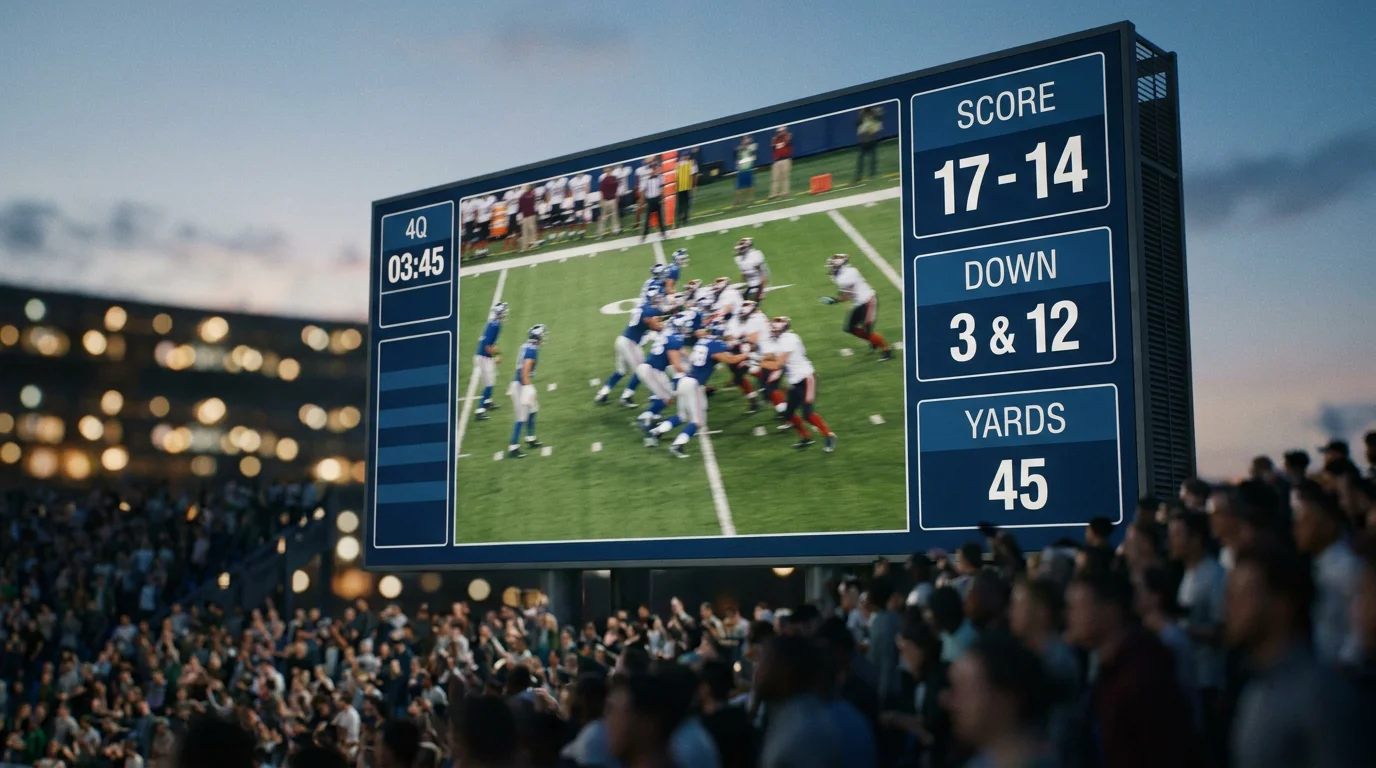
The Q1 2025 Gambling Survey for Great Britain found 15 per cent of British men placed a sports bet in the quarter against 4 per cent of women, and the gender skew is sharper still in the NFL micro-audience. That tells you something about the trader the books expect on the other end of an NFL spread: experienced enough to read the line, confident enough to back it, and almost always working from a soccer mental model that needs unlearning.
| Market | What you are pricing | Typical UK presentation | Where the action concentrates |
|---|---|---|---|
| Moneyline | Straight winner of the game | Fractional or decimal odds on each side | Underdog plays and tight spreads |
| Point spread | Margin of victory adjusted by the handicap | Quoted as a handicap line (-3.5, +7) at near-even odds | The signature NFL market |
| Total (over/under) | Combined score of both teams | A number (44.5, 51) with two-way odds | Weather, pace and matchup-driven trading |
The thing that distinguishes American football from football is the symmetry of pricing across these three. On a Premier League fixture the moneyline (1X2) absorbs most of the volume; the handicap and totals trail behind. On an NFL fixture all three trade actively, the spread is the headline market, and the total often draws as much volume as either of the other two.
Moneyline: just pick the winner, with a catch
The moneyline is the simplest market on the coupon and the one most likely to flatter a Premier League brain into a mistake. You are picking the outright winner of the game. There is no draw to worry about — overtime resolves almost every NFL fixture — so the market is a clean two-way book, priced as fractions or decimals depending on which UK operator you are using.
The catch is that an NFL moneyline routinely carries prices that would be screamingly unattractive in a football match. A 13.5-point home favourite might trade around 1/7 to win outright. That is a 12.5 per cent return on a winner, with a non-trivial chance of losing to a backdoor cover or a defensive touchdown changing the script. Most experienced NFL punters use the moneyline sparingly: on shorter favourites where the spread is awkward, on home dogs you genuinely fancy to win outright, or as a building block inside a same-game multi.
Point spread: the signature American market
The point spread is what makes an NFL coupon feel American. A team is given a handicap — positive for the underdog, negative for the favourite — and the bet pays at near-even odds, typically around 10/11 fractional or 1.91 decimal on either side. Cover the spread and you win. Fail to cover by exactly the number and the bet "pushes" and stakes are returned.
| Team | American | UK fractional | Decimal | Implied probability |
|---|---|---|---|---|
| Bills -3.5 | -110 | 10/11 | 1.91 | 52.4% |
| Browns +3.5 | -110 | 10/11 | 1.91 | 52.4% |
That 52.4 per cent plus 52.4 per cent equals 104.8 per cent total book — the 4.8 per cent overhead being the bookmaker's margin on a standard NFL spread. Spreads concentrate around key numbers, most notably 3 (the field goal) and 7 (the touchdown plus extra point), because those are the most common winning margins in the league's actual scoring history. A line of -3 plays meaningfully differently from -3.5, and shopping a half-point at the right number is one of the few genuine edges available to a recreational punter.
Totals: the market the British punter underuses
The total — over/under on combined points — is the market the soccer-trained punter is least equipped to read on arrival. A typical NFL total sits between 39 and 53; you are predicting whether the two teams together will score above or below that number, irrespective of who wins.
What makes totals interesting is how much information feeds them. Wind speed, dome versus outdoor, expected pace of play, both teams' offensive tempo and defensive efficiency, injury news at quarterback or in the secondary — all of it pushes the number around in the week before kickoff. Because the totals market is symmetric and liquid, the overround on a flagship NFL game is often the tightest single price on the coupon. If you only ever back one type of NFL market, a thoughtfully constructed totals position is frequently the best-value entry point on a Sunday slate.
Reading the price: American, fractional and decimal on one slip
The first time you see -110 next to a spread on a UK book, then 10/11 next to it in fractional, then 1.91 in decimal, the temptation is to assume two of the three are wrong. They are not. They are the same number expressed three ways, and learning to switch between them in your head is a five-minute investment and a permanent edge.

Implied probability — the probability of an outcome that a given odds price reflects, before the bookmaker's margin is removed. A 10/11 price implies a 52.4% probability.
Here is the same -3.5 spread quoted across the three formats, with a worked conversion:
| Format | Quote | Stake | Return (winner) | Profit |
|---|---|---|---|---|
| American | -110 | £11 | £21 | £10 |
| Fractional | 10/11 | £11 | £21 | £10 |
| Decimal | 1.91 | £11 | £21.01 | £10.01 |
The conversion rules are mechanical. For a fractional like 10/11, divide top by bottom (0.909) and that is the multiplier on your stake. Add 1 and you have decimal (1.909, rounded to 1.91). For a positive American price like +250, divide by 100 (2.5) and that is the fractional fraction in decimal terms — so +250 is 5/2 fractional, 3.50 decimal, 28.6% implied probability. For negative American like -110, divide 100 by the absolute value (100/110 = 0.909) and you are back to 10/11. Memorise -110 = 10/11 and you have the spine of every NFL spread you will ever see.
Overround — the sum of the implied probabilities on both sides of a two-way market. Anything above 100% is the bookmaker's theoretical margin on the book.
The overround is where the bookmaker lives. Standard NFL spread and total markets in the UK price up at roughly 4 to 5 per cent overround. Moneyline books on short-favourite games can run closer to 3 per cent, while heavy-favourite moneylines and exotic prop books can balloon to 8 or 10 per cent. Line-shopping is not a clever trick; it is the basic discipline of taking the side of a two-way market at the best available implied probability across the books you have accounts with. Two pence here and three pence there compound across a season more than any tip-sheet ever will.
Everything from this point on assumes you can read a price without translating in your head. If that still feels like work, our deeper breakdown of how NFL odds work for UK bettors walks the full vig-stripping and probability maths in detail.
Player props and the same-game multi: where the slip gets clever
A friend who works on the trading floor at a UK book once described the modern NFL bet builder as "the most expensive product the punter does not realise is expensive." He meant the margin. The headline price on a four-leg same-game multi might look generous, but the implicit overround on a stack of correlated legs can run two or three times what you would pay on a clean spread.

Props — short for proposition bets — are individual-event markets that price a single player or game occurrence rather than the final result. Anytime touchdown scorer, passing yards over/under, longest completion, total sacks, even coin-toss outcomes on the Super Bowl. The same-game multi combines multiple props from a single fixture into a single wager at a combined price.
Why props matter to the British punter — UK books have invested heavily in NFL prop coverage because it is where the new audience plays. A first-time NFL bettor is far more likely to back "Josh Allen anytime touchdown scorer" than to take Bills -3.5, even if the latter is the sharper bet. The bookmakers know it, the prop books reflect it, and the margins live there accordingly.
The leg types you will see most often are quarterback passing yards (set as a number with over/under), rushing yards on the lead running back, receiving yards on the top wideouts, anytime touchdown scorer, longest reception or completion, and total team points. Defensive props (sacks, interceptions) and special-teams props (longest field goal) exist but trade thinner and are routinely priced with wider overround.
Correlation is the concept that makes same-game multis interesting and dangerous. A leg saying "Bills score over 27 points" and another saying "Josh Allen passes for over 250 yards" are positively correlated — if one hits, the other is more likely to hit. UK books restrict the most obviously correlated combinations or reprice them downward, but plenty of soft correlations remain. The same logic works against you: stacking three legs that all depend on the same offensive script is not three independent bets. The deeper anatomy sits in our full breakdown of NFL player props and same-game multis.
Super Bowl and futures: pricing the long horizon
I have a standing rule on futures: nothing goes on a Super Bowl winner until the second week of the regular season at the earliest, and even then only if I have an opinion the closing line is going to disagree with by November. The offseason book is a margin trap dressed up as a value market.

Futures are season-long markets that price events months in advance: Super Bowl winner, conference winners, divisional winners, regular-season MVP, awards markets, season win totals. Around 68 million American adults placed a bet on Super Bowl LVIII in February 2024, with total handle estimated at around $23.1 billion, and the UK share of that — while a fraction of the US figure — represents the single biggest betting event in the British NFL calendar.
The NFL signed an 11-year media-rights package worth $111 billion, with an opt-out clause in 2029. The economic foundation under the betting growth is not soft money. The league has financial visibility into the next decade, and the books are pricing accordingly.
The mechanics of a Super Bowl outright book are straightforward. All 32 teams are priced individually, the sum of the implied probabilities adds up to between 115 and 130 per cent depending on the time of year, and that overhead is the bookmaker's margin on a 32-runner book. Heavily favoured teams trade between 4/1 and 8/1; long shots stretch to 200/1 or longer. Prices move sharply on injury news, trade deadline movement and once the playoff bracket starts to form.
Hedging is the discipline that separates the punter who enjoys a winning future from the one who watches it evaporate in the Super Bowl. If you backed a team at 25/1 in August and they are now 5/2 in late January, you can lock in a guaranteed profit by laying off proportional stakes on the opponent at the right price. The maths is mechanical and worth learning before you ever place the original ticket. For a deeper read on the season's specific market — outright pricing, conference and divisional futures, MVP overlays and prop-night construction — our full breakdown sits at Super Bowl LX outright and prop markets.
The London Games and why the lines move when the NFL flies over
I have been at every London game since the Jaguars first staged a "home" fixture at Wembley, and the experience inside the stadium has changed more than any other I cover. The crowd is louder, the jerseys more diverse, and the betting slate around the fixture has gone from a curiosity to a serious midweek market with sharp prices and real volume.
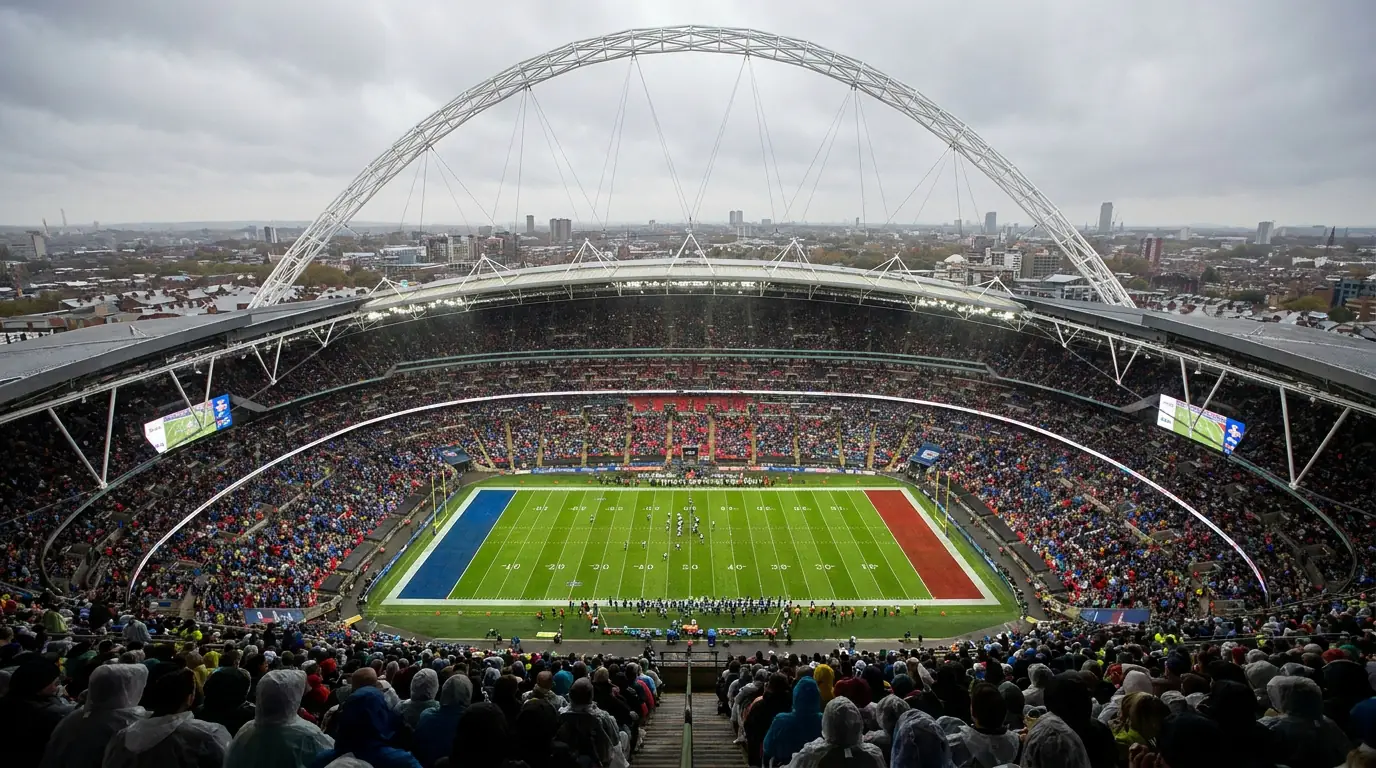
The numbers behind the London Games tell the growth story without ornament. Thirty-nine NFL regular-season fixtures have been staged in the UK since 2007. The Jaguars-Patriots fixture at Wembley in October 2024 set a London attendance record at 86,651. The 2025 London Games drew more than six million UK viewers across television and streaming — a record for the league's international series. Roger Goodell, the NFL Commissioner, has been increasingly direct about what comes next: "There's no question that London could support, not just one franchise, I think two franchises. That's from a fan perspective, from a commercial standpoint, from a media standpoint."
The Jacksonville Jaguars have played 14 fixtures in the UK — more than any other team — and YouGov ranks them inside the top five most popular NFL teams in Britain. They are functionally the UK's adopted franchise, and the line on a Jaguars Wembley fixture reflects it.
The trader's question is what all of this does to the price. Three things, broadly. First, the line on a London fixture absorbs significantly more UK money than a comparable Sunday-night fixture in the US, which pulls the spread toward the team with the larger British fanbase rather than the sharper modelling case. The Jaguars are routinely priced shorter at Wembley than their roster justifies on a neutral field. Second, travel and time-zone effects are real but quantitatively smaller than punters assume — the "jet-lag dog" angle is no longer the free money it was a decade ago. Third, market depth on a London game is now genuinely competitive, so the value windows close faster than they did even three seasons ago.
If you want the full anatomy — Wembley versus Tottenham pricing differences, the time-zone overlay on live markets, the franchise-relocation context and how to handicap a London fixture without falling for the Jaguars trap — our deeper read sits at betting around the NFL London Games.
Choosing where to place an NFL bet in the UK
A serious NFL punter does not have an account; he has accounts. The single biggest structural mistake recreational bettors make is sticking with one operator out of inertia, then paying the difference every weekend in worse prices and narrower markets.

The UK licensing context is the floor under any operator decision. Britain ran 5,825 high-street betting shops as of March 2025, with 8,234 licensed gambling premises in total. Online operator licences are issued by the Gambling Commission, and the bar is high enough that the regulatory rails do meaningful work behind every UK-facing book you can deposit with. Operators without a UKGC licence have no business taking your money, and any site marketing to British punters from a foreign jurisdiction should be treated as a problem.
What "UKGC-licensed" actually buys you — segregation of customer funds, mandatory dispute resolution, advertising standards, age-verification rigour, GAMSTOP integration and access to the Independent Betting Adjudication Service. None of which a book operating under a Caribbean licence will replicate.
Beyond the licence, the practical criteria for choosing where to place an NFL bet are mostly about depth and pricing rather than promotional flash. The criteria I weight, in order:
NFL market depth
Does the operator price every game on the slate, or only the marquee fixtures? A serious NFL book will list spreads, totals and moneylines on all 14 to 16 weekly fixtures plus first-half, second-half, quarter and team total markets on the headline games.
Prop and bet-builder coverage
How many players have prop markets, and how flexible is the same-game multi tool? A flagship Sunday fixture should offer 40-plus player props per team and a bet builder that allows cross-team correlation where legal.
Live and in-play range
Second-half lines, live spreads, live totals and live player-prop windows. Books that go dark in the second quarter are missing the most interesting trading windows of the game.
Pricing on signature markets
Spread pricing on flagship games is the single best test of a book's seriousness. A book quoting -120 on both sides of a spread is asking 9 per cent overround for the privilege; a book quoting -108 is asking 3.7 per cent. Over a season that is the difference between profit and loss.
What I do not weight, and you should not either, is the size of the welcome offer. A £30 free bet is a one-time payment for an account you may use for ten seasons. Prioritise the pricing, depth and protections that compound over that horizon.
Finally, do not under-rate the importance of having more than one operator. Two-account line shopping captures most of the available pricing edge for a recreational punter; three-account shopping captures almost all of it. The half-pip gain on a single bet compounds across the season into real money.
Bankroll, staking and the discipline that beats the tipster
The most expensive mistake I see new NFL punters make is not bad picks. It is bet sizing. A correct read on a 53 per cent spread is worthless if the punter staked it eight times the size of his previous loser in the same evening, and the longest losing run of an objectively profitable strategy is brutal enough to bankrupt anyone who has not done the maths in advance.

An NFL season is 18 weeks of regular play plus the playoffs. A disciplined recreational punter typically places between five and twenty NFL bets a week, which across a full season is somewhere between 100 and 350 positions. Returns are dominated not by which side you took on a given Sunday but by the consistency of your staking and the discipline of your shopping.
Do
- Define a season bankroll in advance, separate from your current account, and treat it as committed capital.
- Stake a flat percentage — typically 1 to 3 per cent — of bankroll per bet, recalculated weekly rather than per game.
- Keep a written record of every bet with the line, the price and the stake, reviewed monthly.
- Shop the line across at least two accounts before placing any bet above your smallest unit size.
- Take losing streaks as data, not as catalysts to chase.
Don't
- Increase stake size on the back of a winning weekend or a "feeling".
- Place a bet you cannot explain in a single sentence to yourself.
- Treat free bets as found money — they are wagering credits with terms attached.
- Bet to recover a loss inside the same session.
- Use cash-out without understanding the implicit margin you are paying for it.
The simplest staking system, and the one I recommend to anyone starting out, is flat percentage. Pick a number between 1 and 3 per cent of bankroll. That is your unit. Every standard bet is one unit. Every confident bet — and the bar for "confident" needs to be high — is two units. Never three. A fractional Kelly system can be tighter once you have a real edge to size against, but most recreational NFL punters overestimate theirs by a factor of two or three.
Before you press confirm
- What is the line, in implied probability terms, and what is my read in probability terms?
- Have I checked at least one other UK book for a better price?
- Is this stake within my standard unit?
- Am I betting on a view of the game, or on a feeling about the team?
- What is the worst-case scenario if this bet loses, and am I comfortable with it?
Five questions, thirty seconds, every time. That habit alone separates the punter who has a profitable season from the one who does not.
Responsible NFL betting: the rails the UK has built
There is a temptation, when writing about responsible gambling, to retreat into footer-style disclaimers and "if you need help, call this number" copy. I am going to do the opposite, because the data on harm in the UK is too serious for vague footnotes.

The Adult Psychiatric Morbidity Survey covering 2023 and 2024 found that 0.4 per cent of adults in England score 8 or higher on the Problem Gambling Severity Index, and 1.6 per cent score 3 or higher. Among 18-to-24-year-olds the picture is sharper still: 21.9 per cent score in the PGSI 1-to-27 band and 5.3 per cent in the highest-risk 8-to-27 category. NHS specialist gambling clinics recorded 1,914 referrals in a recent six-month period against 836 in the equivalent period the year before — a near-doubling — and the service network has expanded to 15 clinics nationally.
GAMSTOP, the national online self-exclusion scheme, passed 600,000 total registrations by mid-2025, with approximately 525,000 active self-exclusions on the register. Registrations grew by 100,000 in 11 months. This is not a niche service. It is a mass-scale piece of national gambling infrastructure used by the equivalent of a medium-sized British city.
The mechanics matter and they are simple to summarise. Deposit limits can be set at every UKGC-licensed operator and apply per day, week or month. Loss limits sit alongside deposit limits. Reality checks force a pop-up after a set play period. Self-exclusion at a single operator removes you from that operator's marketing and play for a set period. GAMSTOP removes you across every UK-licensed operator simultaneously for six months, one year or five years.
Baroness Twycross, the Parliamentary Under-Secretary at DCMS, framed the direction directly in early 2025: "The levy represents a watershed moment: a significant uplift in the investment dedicated to this area; greater government oversight; and a renewed commitment to further understanding, tackling and treating gambling harms." The statutory levy, the NHS clinic expansion and the GAMSTOP integration are pieces of the same infrastructure, and they exist because the harm data made them necessary.
The rails are there to be used. Setting a deposit limit is not an admission of weakness; it is the same act of bankroll discipline I described in the previous section, enforced by the operator rather than by your willpower at 11pm on a Sunday. Use them. If you genuinely need to step away, GAMSTOP is one online form and you are out across the entire UK market in under five minutes. The framework for what to set, how to set it and where to find help is laid out in our full piece on responsible NFL betting under UKGC rules.
Regulation, licensing and the 2025 statutory levy
If you had asked me in 2020 to summarise UK gambling regulation in a sentence, I would have said: the Gambling Commission licenses, the operators self-regulate, and the harm-research sector relies on voluntary industry contributions. None of those three clauses is fully true today.

The headline change is the statutory levy. The Gambling Levy Regulations 2025 came into force on 6 April 2025, setting a 1.1 per cent levy on online operator gross gambling yield, with a 0.1 per cent floor for smaller operators. The first statutory payment was due from operators by 1 October 2025 for the 2025/26 financial year. From 2025 NHS England formally took full responsibility for managing the treatment arm of the levy framework — ending the previous reliance on industry-controlled charitable funding.
Why the levy matters to a punter — operators do not pass the 1.1 per cent through to customers as a visible charge, but the cost feeds into the margin equation. The slow tightening of welcome offers, the reduction in promotional generosity and the more conservative free-bet wagering terms across the UK market are all, in part, levy-and-affordability driven. The bookmaker overhead has gone up, and the punter sees it in the small print rather than the headline price.
The wider regulatory direction is captured in the parliamentary record. Baroness Twycross summarised it in February 2025: "Online slots are the highest-risk gambling product. They have the highest rate of binge play and the highest average losses of any online product. In the past five years, this yield has grown by 61 per cent and growth is not slowing down." That quote tells you where political attention is fixed and where regulatory pressure will continue to land. Sports betting — and NFL betting specifically — sits in a relatively favoured part of the policy landscape because the per-session loss distribution is calmer and the engagement pattern is naturally event-bounded.
What you should expect over the next three to five seasons: tighter affordability checks on larger deposits, more conservative bonus marketing, more visible safer-gambling tooling, and a continuing expansion of NHS-funded treatment services.
The NFL season calendar through a UK betting lens
Every September a portion of my regular clients ask the same question: when does the NFL "really" start, and when should they start staking seriously? The answer is the same every year. The regular season starts in early September, but the trading season does not really begin until around Week 4.
What follows is the calendar I work to. Adjust to taste, but the rhythm of the season is uniform year to year.
The preseason runs through August and is broadly untradeable. Skip it. Week 1 opens the regular season and is the lowest-information week of the year — eight months without a competitive snap means the lines are softer in both directions than they look. By Week 3 you have enough data to start trusting the modelling; by Week 4 you have a season's worth of patterns visible. From Week 4 through Week 14 is the meat of the trading year.
The London Games, traditionally clustered in late September through October, are scattered set pieces inside the schedule. They draw oversize UK volume and oversize British media attention; the lines reflect both. Cumulatively since 2007 the UK has hosted 39 regular-season fixtures, with the Wembley attendance record of 86,651 set in October 2024. Treat the London week as a separate sub-market with its own pricing dynamics rather than as a regular Sunday slate.
Thanksgiving in late November delivers three Thursday fixtures and is one of the trickier weeks of the year — short-week preparation distorts the spreads. December is when divisional implications start tightening every line. The playoff bracket forms in early January and the seven-week run to the Super Bowl in February delivers the densest betting calendar of the year. The Super Bowl draws something between 60 and 70 per cent of the season's recreational NFL betting volume in a single Sunday night.
From mid-February through August the calendar empties. Draft markets in late April, schedule-release reaction in May, and then a long offseason that experienced punters use to research rather than to bet. Save the bankroll for September.
Common questions from UK NFL punters
Is NFL betting legal in the UK?
Yes. NFL betting is fully legal for anyone aged 18 or over through any operator holding a Gambling Commission licence. The UKGC regulates online and high-street bookmakers in Great Britain, and a legitimately licensed operator will display its licence details in the site footer. There are no NFL-specific restrictions distinct from those that apply to football or racing. Operators marketing to UK customers without a UKGC licence are operating outside the legal framework and should be avoided.
How do American moneyline odds convert to UK fractional odds?
Two formulas cover every case. For a negative American price like -110, divide 100 by the absolute value: 100 ÷ 110 = 0.909, which is 10/11 fractional and 1.91 decimal. For a positive American price like +250, divide by 100: 250 ÷ 100 = 2.5, which is 5/2 fractional and 3.50 decimal. Most UK books allow you to toggle the display format in account settings, so once you have done the conversion once you can choose the format that suits you and stay in it.
What is the difference between a point spread and a handicap?
Mechanically they are the same family of market — both adjust the result by a number of points or goals to balance the two sides. The differences are conventional. NFL spreads are quoted with half-point increments to eliminate pushes around key numbers like 3 and 7, and they trade at near-even odds (typically 10/11 each way) with the bookmaker margin built into the price. UK football handicaps more often use whole-number Asian-handicap conventions and a wider variety of odds.
Which UK bookmakers offer the widest NFL markets?
The major UKGC-licensed operators with serious NFL trading desks all price the full slate, full prop coverage and competitive bet-builder tooling. Rather than ranking individual operators, the right test is to check the spread, total and moneyline coverage on a mid-tier Sunday fixture: a serious NFL book will price every regular-season game with player props, quarter and half markets, and live in-play range. Holding accounts at two or three operators and shopping the line is materially more valuable than picking a single "best" book.
When are the peak NFL betting weeks for UK punters?
The Super Bowl is the single biggest betting event in the British NFL calendar by some margin — typically drawing more wagering volume than the rest of the playoffs combined. After that, the conference championship round, divisional weekend and Wild Card weekend cluster the bulk of late-season activity. In the regular season, the London Games week and Thanksgiving week each spike traffic.
What does Prop Protect or early payout mean on NFL bets?
These are operator-specific promotional features rather than core market terms. Prop Protect, where offered, refunds losing player-prop bets under specific conditions — typically when a player narrowly misses a yardage line. Early payout features settle a bet as a winner if a defined in-game threshold is reached, even if the final result is different. Terms vary by book and by market. Read the full conditions before relying on them, because the practical value of these features is often smaller than the promotional copy suggests.
How can I self-exclude from NFL betting in the UK?
GAMSTOP is the national self-exclusion scheme covering every UK-licensed online operator. You complete a single online registration, choose a period of six months, one year or five years, and you are blocked from accessing accounts at every UKGC-licensed online gambling site for the duration. GAMSTOP cannot be limited to a single sport — exclusion is total across online operators. If you want to step away from a single operator only, every UKGC-licensed book also offers a single-operator self-exclusion process via their own account tools.
What a disciplined British NFL punter actually does
The honest summary of everything above is that NFL betting in the UK rewards the same disciplines as any other sport, executed with markets that are mechanically different from the football coupon most British punters cut their teeth on. The spread is the headline market. The total is a serious participant rather than a sideshow. The bet builder is a creative tool that becomes a margin trap when stacked uncritically. The regulatory rails are tighter than they have ever been, and the responsible-gambling infrastructure — GAMSTOP, the NHS clinic network, the operator-level deposit and loss limits — is genuinely usable rather than ornamental.
What separates the punter who finishes a season ahead from the one who does not has very little to do with picks. It is the discipline of staking a flat percentage of bankroll, shopping the line across two or three accounts, knowing where the bookmaker margin lives, and using the season calendar to bet seriously in the windows where the modelling is reliable and lightly in the windows where it is not. The pieces are not glamorous. They compound. Read the price, set the limit, place the bet, log the result. Repeat for 18 weeks plus the playoffs. That is the job.
